Mortgage Matters With Integrity
|
|
|
|
Written & Prepared by: Brian Tilton
|
|
|
|
|
|
|
|
|
Mortgage Insights:
30 Year Loan with Extra Principal Payments vs 20 Year or 15 Year Term
|
|
|
|
One of the most common mortgage questions we get is:
“Should I choose a shorter loan term—or stick with a 30-year and just pay extra when I can?”
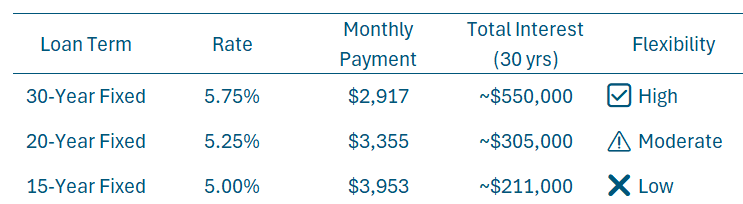
It’s a great question, and the answer depends on your financial flexibility, risk tolerance, and long-term goals. Let’s break down the pros and cons of each approach, and look at how they really impact your loan payoff and total interest costs.
|
|
|
Option 1: 30-Year Loan + Extra Principal Payments
Pros:
-
Lower required payment: Your monthly obligation is lower, giving you more flexibility in tight months.
-
Optional acceleration: You can make additional principal payments anytime, cutting down interest and shortening the loan term—on your own terms.
-
Liquidity advantage: You can divert funds elsewhere (savings, investments, emergencies) when needed.
-
More control: You decide when to be aggressive or conservative with your finances.
Cons:
-
Higher interest rate: 30-year loans typically have rates 0.25–0.75% higher than 15- or 20-year options.
-
Temptation to not prepay: If extra payments aren’t made consistently, you may end up paying significantly more in interest over time.
-
Longer actual term unless disciplined: Without a plan, the full 30-year duration may quietly pass by.
Option 2: 20 Year or 15 Year Fixed Loan
Pros:
-
Lower interest rate: Shorter terms generally come with meaningfully better rates.
-
Forced discipline: Higher required payments build equity faster and ensure you stay on an accelerated payoff path.
-
Less interest paid overall: Even with the same loan amount, you can save tens of thousands in interest.
Cons:
-
Higher required payment: You’re locked into a higher monthly obligation—whether or not it’s a good month financially.
-
Reduced flexibility: Less wiggle room if income drops, expenses spike, or your priorities shift.
-
May affect qualification: Some borrowers may not qualify for the higher payment required on a shorter term.
|
|
|
|
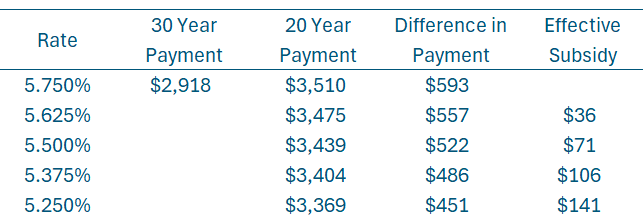
A key benefit of shorter-term loans is the interest rate is generally lower, which helps offset some of the monthly payment increase from the shorter amortization schedule. An example is shown in the table below, whereby a $500,000 loan amount is assumed. If we assume a 5.75% rate for both a 30 year term and a 20- year term, the difference in payment is $593. But, their rates aren’t normally the same; rather a 0.375% – 0.50% reduction is more realistic. If the rate reduction is 0.50% then the difference is payment is $451 and the payment is effectively subsidized by $141.
|
|
|
|
|
|
Another benefit to be aware of: shorter-term loans apply more of your payment toward principal early in the loan. On a 30-year mortgage, it can take 10+ years before even half of your payment is applied to principal. On a 15-year loan, the shift happens quickly, meaning more equity sooner and less total interest paid.
|
|
|
|
|
🧮 What If You Prepay on the 30-Year?
Let’s say you opt for a 30-year loan but consistently pay an extra $500/month toward principal.
Result —> You’ll pay off the loan in ~22 years instead of 30—and save over $170,000 in interest compared to making just the minimum payment.
The key point: If you’re disciplined, you can mimic a shorter loan term while keeping the 30-year safety net in case life throws you a curveball.
💡 Strategic Takeaway
-
If you value flexibility and can stay disciplined, the 30-year with extra principal payments is a great option.
-
If you’re comfortable with a higher monthly commitment and want forced accountability, a 15- or 20-year loan will give your the largest savings.
-
Bonus idea: Start with a 30-year term, set up automatic extra payments (e.g., biweekly or a fixed monthly boost), and reevaluate in 2–3 years. You can always refinance to a shorter term later if your financial picture improves.
Bottom Line:
There’s no one-size-fits-all answer—but knowing your options empowers smarter choices. If you want to model different loan terms or compare savings from extra payments, we’re happy to run the numbers for you.
|
|
|
|
|
|
|
|
|
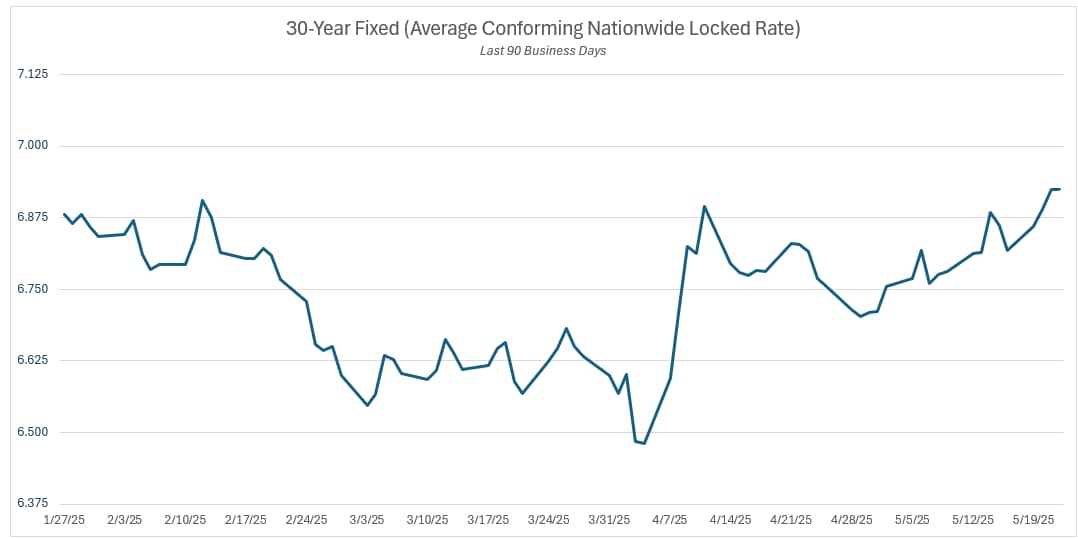
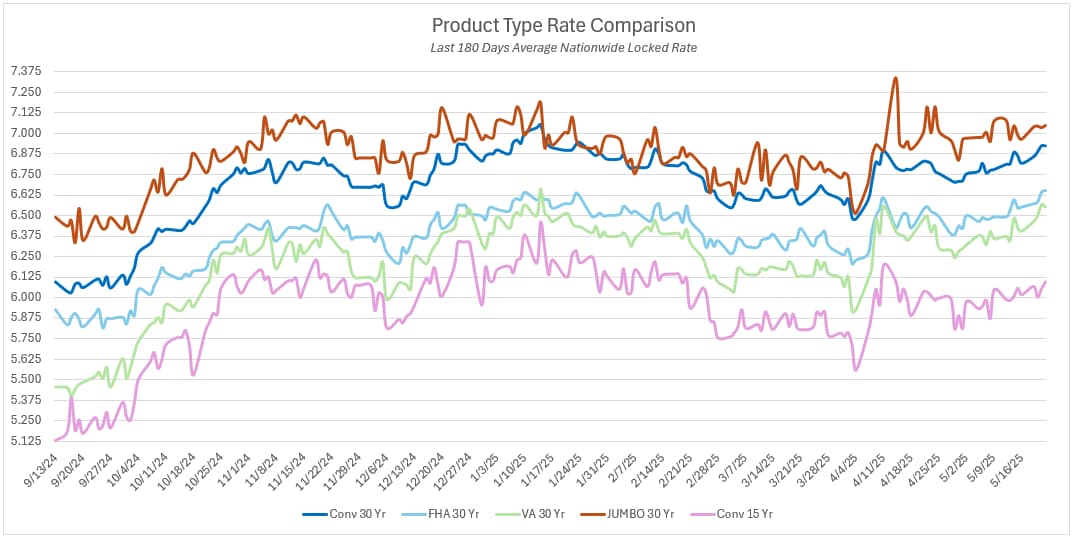
Over the past week, mortgage rates have experienced modest increases:
-
30-Year Fixed: Rates rose by approximately 5 basis points.
-
15-Year Fixed: Up by about 4 basis points.
-
5/1 ARM: Up by roughly 3 basis points.
Product Performance:
-
Conventional Loans: More sensitive to Treasury yield changes, leading to slightly higher rate increases.
-
FHA/Government Loans: Rates remained relatively stable, benefiting from consistent demand and government support.
-
ARMs vs. Fixed-Rate Mortgages: Adjustable-rate mortgages saw smaller rate increases, maintaining their appeal for borrowers seeking lower initial payments.
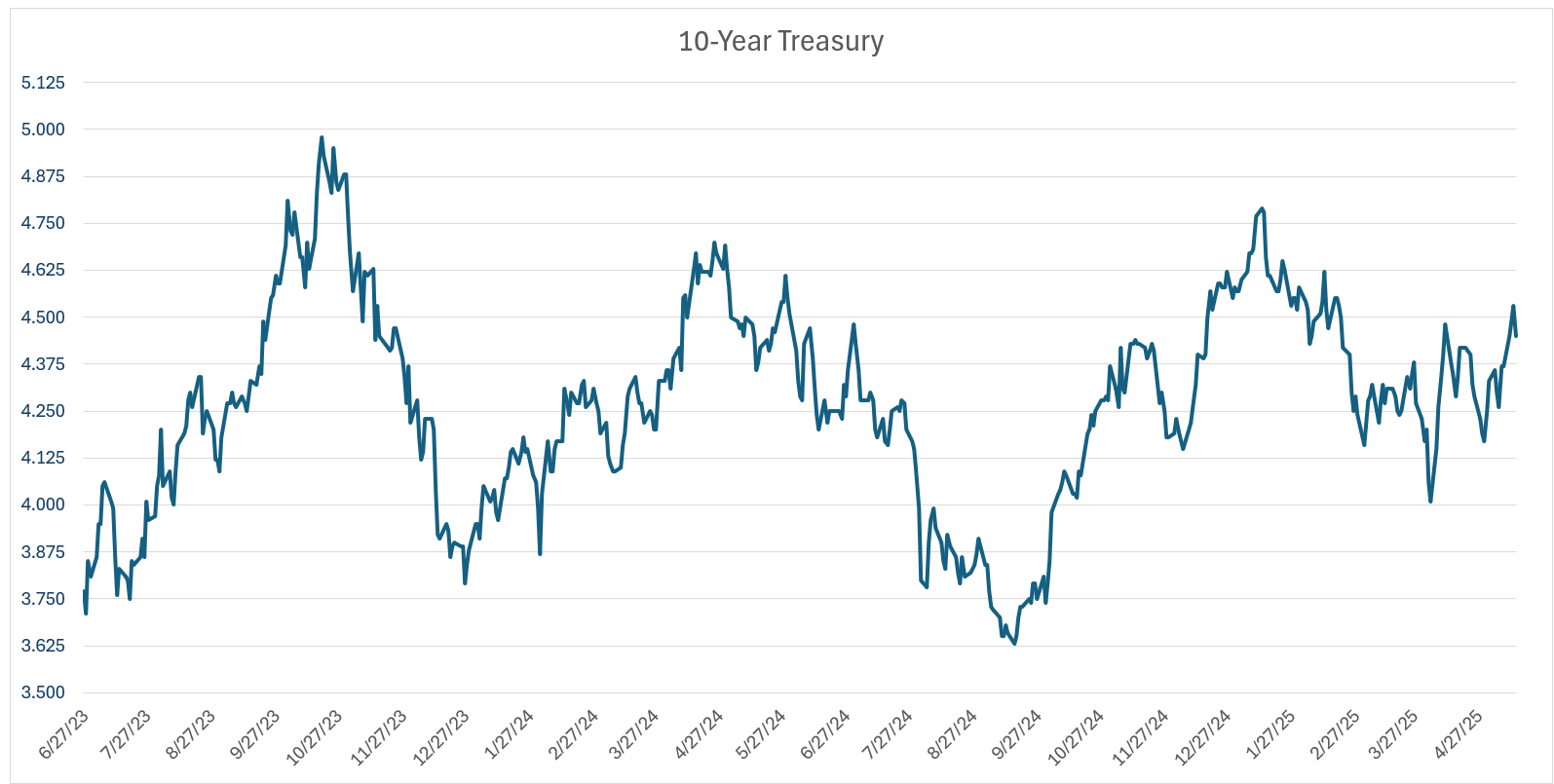
These changes are closely tied to movements in the 10-year Treasury yield, which rose due to several factors:
Moody’s Downgrade of U.S. Credit Rating
On May 16, Moody’s downgraded the U.S. sovereign credit rating from Aaa to Aa1, citing concerns over the nation’s growing $36 trillion debt pile. This downgrade has led to increased borrowing costs, influencing mortgage rates upward.
Congressional Budget Developments
The House recently passed a significant tax-cut bill, projected to increase federal deficits by $3.8 trillion over the next decade. This fiscal expansion raises concerns about inflation and long-term interest rates.
Trade Policy Uncertainty
President Trump announced potential tariffs, including a 50% levy on European Union goods and a 25% tariff on iPhones manufactured outside the U.S. These threats have unsettled markets, contributing to rate volatility.
Yield Curve Dynamics:
The yield curve experienced a slight steepening, with long-term rates rising more than short-term rates. This shift suggests growing investor concern over long-term inflation and fiscal policy impacts.
Looking Ahead:
Borrowers should stay informed about:
-
Upcoming Economic Data: Particularly the jobless claims and GDP revision, which could influence rate movements.
-
Legislative Developments: Ongoing debates in Congress regarding fiscal policy may impact investor sentiment and, consequently, mortgage rates.
-
Global Trade Policies: Further announcements on tariffs could introduce additional market volatility.
|
|
|
|
|
|
|
|
|
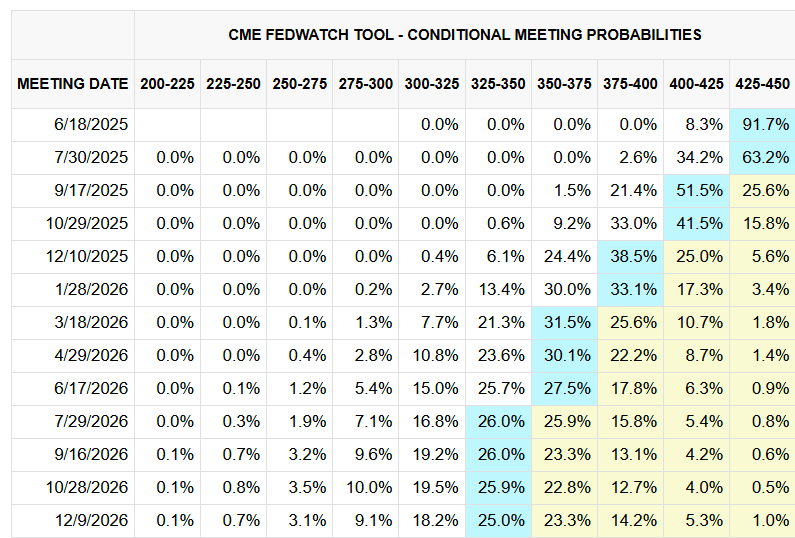
As of today, financial markets are pricing in a mere 8.3% probability of a 25 basis point cut in the Fed Funds rate at the next Fed meeting; therefore a 91.7% probability of no change. Looking further out to the July 30th FOMC meeting, the market is pricing in a 34.2 probability of a 25 basis point cut, and a 2.6% probability of a 50 basis point cut.
Key factors fueling this shift in probabilities include:
-
Persistent Inflation: The Fed’s target is 2% inflation, but recent data (3.4% CPI) shows prices are still stubborn. This keeps the Fed hawkish, leaning toward keeping rates high to cool demand.
-
Labor Market Strength: Unemployment’s at a cozy 3.9%, signaling a hot job market. A strong labor market fuels spending, which can stoke inflation—prompting the Fed to hold rates steady or hike them.
-
Economic Growth: Q1 2025 GDP growth was revised to 1.6%, a slowdown from Q4 2024’s 2.5%. The Fed’s watching to see if this cooling continues, which could open the door to rate cuts if growth stalls.
-
Tariff Uncertainty: Where tariffs go from here is a huge wildcard, which the Fed is watching closely. The economic impact of tariffs is expected to increase the cost of products (i.e. inflation) which decreases the odds of a Fed cut. The big question is whether tariffs are a short-term negotiating tactic, which will be reversed, or a long-term policy.
Why does this matter to borrowers?
The federal funds rate is like the thermostat for borrowing costs. When the Fed raises it, banks pay more to borrow, and they pass those costs to you via higher mortgage rates. But if the Fed cuts rates, mortgage rates could ease, making homebuying more affordable.
|
|
|
Next FOMC Meeting: Wednesday, June 18
Current Fed Funds Rate Range: 4.25% – 4.50%
|
 |
|
|
 |
|
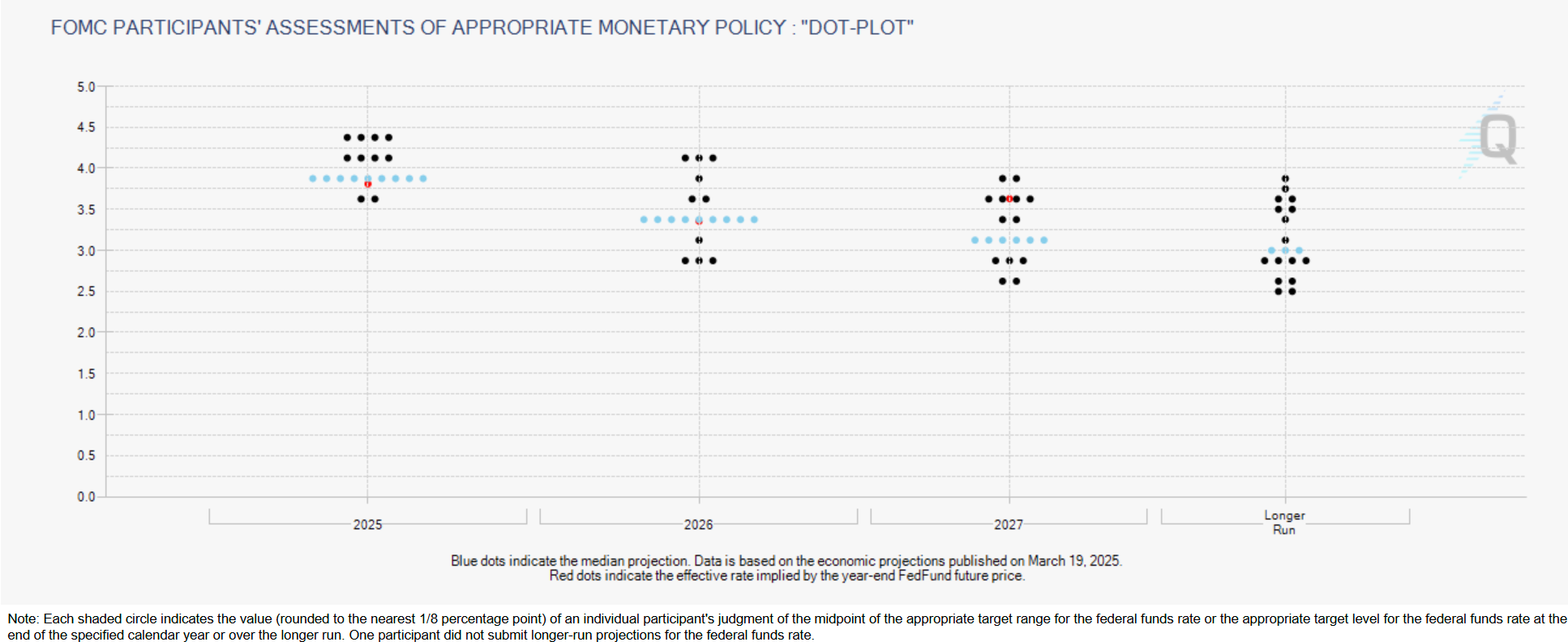
How to Read the Fed’s Dot Plot (chart below)
● Each dot represents one FOMC member’s forecast.
● There are 19 participants in the dot plot:
-
▪︎ 7 Fed Board Governors (nominated by the President and confirmed by the Senate
-
▪︎ 12 Regional Fed Bank Presidents
● The red dot shows the market’s forecast, based on the price where futures are trading.
● The blue dots represent the median forecast.
● The greater the dispersion in the dots, the less consensus between the participants.
Usefulness for Borrowers: Provides an educated indication of where the Fed Funds rate may be in future years.
|
|
|
|
|
|
|
|
Question: Why should I stay abreast of upcoming economic news?
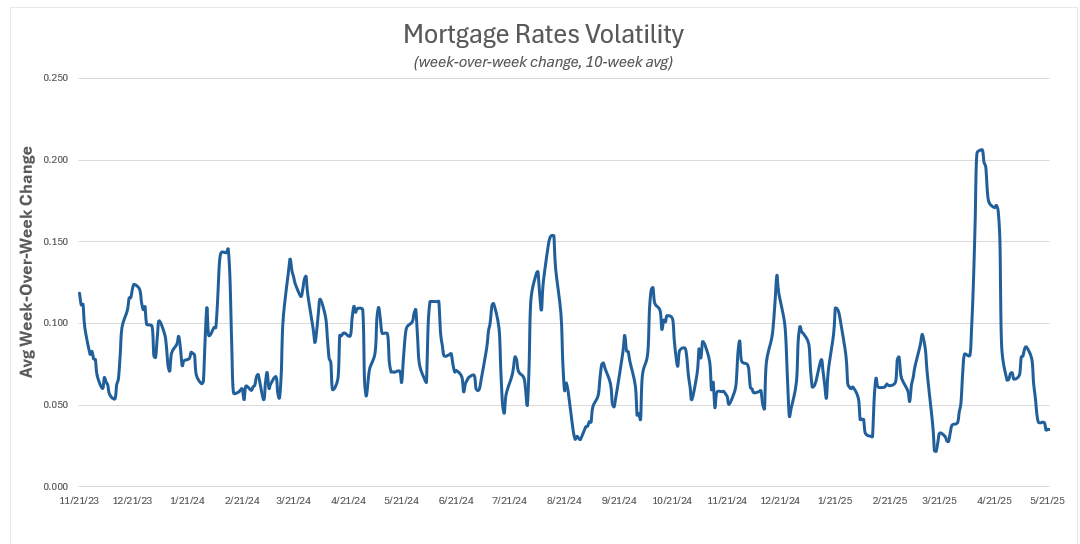
Answer: Financial markets react to disparities between expected versus actual economic data. On days where highly anticipated economic data is released there is a greater likelihood of heightened volatility (risk). This is particularly relevant if you are locking it a rate.
|
|
|
|
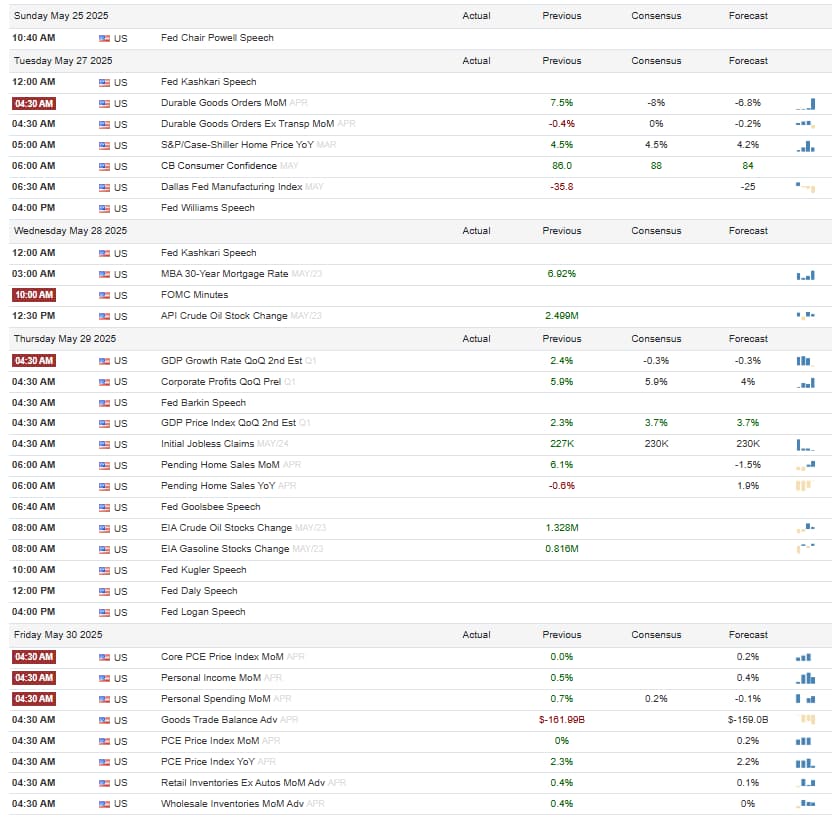
Here’s a rundown of this week’s key economic data being released — what’s coming & why it matters:
-
What: Initial Jobless Claims. This weekly report measures the number of individuals filing for unemployment benefits for the first time. It’s a timely indicator of labor market strength.
When: Thursday, May 29, 5:30 AM PST
Market’s Expectation: Approximately 220,000 new claims.
What to Watch For: An unexpected increase in claims could signal a cooling job market, potentially leading to lower mortgage rates as economic growth slows. Conversely, fewer claims might indicate a robust labor market, which could put upward pressure on rates. Volatility Risk: ⚠️ Moderate
-
What: Q1 GDP (First Revision). The Gross Domestic Product (GDP) measures the total economic output. This first revision provides a more accurate picture of economic growth in the first quarter.
When: Thursday, May 29, 5:30 AM PST
Market’s Expectation: An upward revision from the initial estimate of a 0.3% annualized contraction.
What to Watch For: A significant revision could influence investor sentiment. A stronger GDP might lead to higher mortgage rates due to expectations of continued economic growth, while a weaker figure could have the opposite effect. Volatility Risk: ⚠️ Moderate
-
What: Pending Home Sales Index (April). This index tracks the number of homes under contract but not yet closed, serving as a leading indicator for housing activity.
When: Thursday, May 29, 7:00 AM PST
Market’s Expectation: A slight increase from the previous month.
What to Watch For: An uptick suggests growing buyer interest, which could support home prices and potentially lead to higher mortgage rates. A decline might indicate cooling demand, possibly easing rate pressures. Volatility Risk: ⚠️ Moderate
|
|
|
|
|
|
|
Navigating the New Realtor Commission Landscape: A Guide for Homebuyers
While this isn’t breaking news, its nevertheless important for homebuyers to be aware of and understand a significant transformation that the real estate industry underwent in August 2024. This change was prompted by a landmark $418 million settlement from a federal lawsuit against the National Association of Realtors (NAR). Effective August 17, 2024, these changes have altered how commissions are managed, impacting homebuyers and sellers nationwide, including in California’s high-stakes housing market. This guide educates borrowers on the changes, their implications, the current market response, and actionable steps to navigate this new landscape.
Background on the Commission Changes
The Old System
Before August 2024, sellers typically paid commissions for both their agent and the buyer’s agent, totaling 5-6% of the home’s sale price; usually split evenly (e.g., 2.5% each). For a $500,000 home, this meant $30,000 in commissions, with $15,000 per agent. The buyer’s agent commission was listed on the Multiple Listing Service (MLS), a database for real estate professionals. Critics argued this system reduced competition, as agents might prioritize listings with higher commissions, thereby keeping commission rates high.
The Lawsuit and Settlement
In March 2024, NAR settled an antitrust lawsuit brought by home sellers claiming inflated commissions due to NAR’s rules. The settlement introduced reforms to enhance transparency and competition, effective August 17, 2024:
-
No MLS Commission Offers: Sellers’ agents cannot advertise buyer’s agent commissions on the MLS.
-
Buyer-Agent Agreements: Buyers must sign a written agreement with their agent before touring homes, specifying the agent’s services and commission.
-
Direct Buyer Responsibility: Buyers are responsible for their agent’s commission unless the seller offers to cover it through concessions.
These changes strive to make commissions more transparent and negotiable, potentially lowering costs for consumers.
Implications for Homebuyers
Financial Impact
Buyers may now need to pay their agent’s commission directly, adding to upfront costs. For instance:
-
On a $400,000 home, a 2.5% commission is $10,000.
-
In California, with a median home price of $875,000 (early 2025, per California Association of Realtors), a 2.5% commission is $21,875.
Buyers can negotiate with their agent for lower rates or ask sellers to cover the fee as a concession, such as a closing cost credit. This shift makes financial planning crucial, as commissions cannot be financed into a mortgage.
Opportunities for Savings
Removing standardized commission offers from the MLS fosters competition among agents. Buyers may negotiate:
-
Lower Rates: Some agents may accept 1-2% instead of 2.5-3%.
-
Flat Fees: Fixed fees (e.g., $5,000) regardless of home price.
-
Alternative Models: Discount brokerages like Redfin offer lower rates (e.g., 1.5% listing fees).
In California, where high home prices amplify savings, a 1% commission reduction on a $875,000 home saves $8,750. The Consumer Federation of America suggests aiming for 2% or less per agent.
Risks of Going Without Representation
To avoid commission costs, some buyers might skip an agent, but this is risky in California’s complex market. Without an agent, buyers may struggle to:
-
Navigate bidding wars and competitive offers.
-
Understand legal and financial complexities.
-
Negotiate effectively with sellers.
California-Specific Considerations
California’s median home price of $875,000 makes commission costs significant. However, sellers in high-demand areas like San Francisco and Los Angeles often offer concessions to attract buyers, reducing the financial burden on buyers. The state’s competitive market and legal intricacies make professional representation valuable, despite the new costs.
How the Market Has Responded
National Trends
As of the time of this writing, the impact of the August 2024 changes is modest:
-
Commission Rates: Rates remain around 5-6%, with buyer’s agent commissions at 2.37% in Q4 2024, slightly up from 2.36% in Q3 2024 but down from 2.45% in Q4 2023.
-
Negotiation: Increased discussions around commissions, with some buyers securing lower rates.
-
Buyer Behavior: Only 6% of home sales from July 2023 to June 2024 were without an agent, per NAR data, indicating continued reliance on agents.
-
Seller Concessions: Sellers often cover buyer’s agent commissions to attract offers, especially in competitive markets.
Redfin notes that commissions have risen slightly for affordable homes (under $500,000) and fallen slightly for expensive homes (over $500,000), reflecting market segmentation.
California-Specific Observations
In California, high home prices and transaction complexity limit immediate changes:
-
Stable Rates: Commissions remain at 5-6%, with buyer’s agent fees around 2.5%.
-
Negotiation Uptick: Some buyers negotiate lower rates, but standard rates persist.
-
Seller Behavior: Concessions are common in high-demand areas to make listings appealing.
-
Buyer Reliance: The market’s complexity drives continued use of agents.
Why the Impact Has Been Limited
Several factors explain the slow adoption:
-
Industry Habits: Decades of standard practices are hard to change quickly.
-
Agent Value: In California, agents are crucial for navigating high-stakes transactions.
-
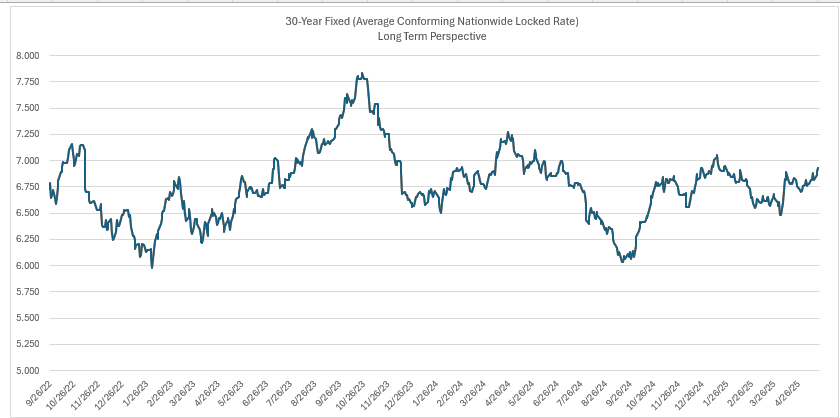
Economic Factors: Comparatively higher mortgage rates (6.9% in May 2025) and low inventory (3.2 months’ supply in California) overshadow commission changes.
-
Adjustment Period: The changes, less than a year old, require time for market adaptation.
Potential Future Impacts
Experts from the Consumer Federation of America predict gradual shifts toward lower commissions as competition increases. In California, even modest reductions could yield significant savings. However, some worry buyers skipping agents could lead to uninformed decisions, particularly for first-time buyers.
Why It’s Important to Act Now
The market’s gradual adjustment offers a window for homebuyers to leverage increased transparency and negotiation potential. By educating yourself and acting proactively, you can save money and avoid pitfalls. Understanding these changes ensures you’re prepared for new financial responsibilities and can advocate for your interests in a competitive market.
Actionable Steps for Homebuyers
To navigate this new landscape effectively, we encourage you to consider these steps:
-
Educate Yourself: Research the new commission rules to understand your responsibilities and opportunities.
-
Shop Around for Agents: Interview multiple agents to compare rates and services. Consider flat-fee or low-commission options, like Redfin’s 1.5% listing fee (Redfin).
-
Negotiate Commission Rates: Discuss lower rates with agents, especially if they represent both buyer and seller, where savings may be possible.
-
Request Seller Concessions: Include a request in your offer for the seller to cover your agent’s commission, a common practice in California.
-
Plan Your Finances: Budget for potential commission costs, as they cannot be financed into your mortgage. Ensure cash reserves for closing.
-
Review the Buyer Representation Agreement: Sign a clear agreement with your agent, required before touring homes, outlining fees and services.
-
Get Pre-Approved: Obtain a mortgage pre-approval to strengthen your offer and clarify your budget, aiding negotiations.
-
Weigh the Value of Representation: Balance commission savings with the expertise an agent provides, crucial in California’s complex market.
The Bottom Line
The August 2024 commission changes have introduced new responsibilities and opportunities for homebuyers. While the market has been slow to adapt, with commission rates stable as of early 2025, proactive buyers can leverage increased transparency to negotiate better deals. In California, where high home prices amplify the stakes, understanding these changes and taking action are critical. By following the steps outlined, you can save money, avoid risks, and make informed decisions in your homebuying journey.
|
|
|
|
|
|
|