|
Mortgage Matters With Integrity
|
|
|
|
Written & Prepared by: Brian Tilton
|
|
|
|
|
Tariffs, Treasuries, and Your Mortgage:
Unpacking Last Week’s Excitement
|
|
|
|
This week, mortgage rates experienced a notable downward shift, driven by a complex interplay of global economic forces, with tariffs taking center stage. For borrowers, understanding these movements can provide valuable insight into the current lending landscape and what might lie ahead. Let’s double-click on this topic.
|
|
|
Tariffs and the Flight to Safety
|
|
|
|
Financial markets were rattled this week as tariff-related headlines dominated the news cycle. Increased tariffs—or the threat of them—tend to stoke uncertainty, as they can disrupt trade flows, raise costs for businesses, and alter economic outlooks. Investors, wary of these risks, responded with a classic “flight to safety.” Funds flowed out of riskier assets like stocks, and into safe-haven investments, particularly U.S. Treasuries. The DOW plummeted a jaw dropping 7.9% on a week-over-week basis, whereas the S&P 500 was down 9.1%.
When demand for Treasury bonds rises, their prices go up, thereby causing their yields (interest rates) to fall. Since mortgage rates are closely tied to the 10-year U.S. Treasury, this shift indirectly benefited borrowers. As Treasury rates dipped, mortgage rates followed suit, offering a welcome reprieve for those looking to lock in a home loan or to refinance the prior three years higher rates.
|
|
|
Volatility: This Week vs. the Past Six Months
|
|
|
|
To put this week’s market movements in context, let’s look at volatility. The Volatility Index (VIX), often called the market’s “fear gauge,” spiked this week, reaching a high of 22 on Wednesday—up from an average of 15 over the prior six months. While this is well below the extreme levels seen during COVID and the Great Recession (like the 80+ readings in 2020), it’s a significant jump from the relatively calm 12-18 range that dominated late 2024. For borrowers, this uptick in volatility underscores how quickly sentiment can shift—and how mortgage rates can be caught in the crosscurrents.
|
|
|
|
What Happens Next? Tariffs High, Low, or Suspended
|
|
|
|
Looking ahead, the trajectory of tariffs will likely play a big role in shaping mortgage rates. Some market observers speculate that the current tariff push might be a negotiating tactic, intended to extract concessions rather than a policy set in stone. If this proves true and tariffs are scaled back, the pressure could ease quickly. However, if it turns out to be more than a bargaining chip, economists warn of a potential economic slowdown, as higher costs ripple through supply chains and consumer prices, dampening growth.
Historically, during periods of economic slowdown, interest rates—including mortgage rates—tend to decline. This happens because weaker growth reduces inflationary pressures, prompting investors to seek the safety of bonds like Treasuries, driving rates lower. Central banks may also step in to stimulate the economy, further supporting a drop in rates. For borrowers, this could mean lower borrowing costs, though it often comes with the trade-off of broader economic uncertainty in the job market.
Here’s how the markets might react under different scenarios:
- Tariffs Remain High: If tariffs stay elevated—beyond a negotiating stance—uncertainty could persist, keeping investors parked in Treasuries. This would likely hold Treasury yields—and thus mortgage rates—lower than they might otherwise be. However, a sustained tariff regime could slow the economy, amplifying downward pressure on rates. Analysts at Goldman Sachs estimate a 40% chance that current tariff levels are maintained through mid-2025, reflecting ongoing trade dynamics.
- Tariffs Are Lowered or Suspended: If tariffs ease, perhaps as a negotiation succeeds, markets could see a reversal. Risk appetite might return, pulling funds out of Treasuries and into equities. Treasury yields (rates) would likely rise, pushing mortgage rates up with them. Borrowers could see rates climb back higher in this scenario. Morgan Stanley pegs the odds of tariff relief at around 25%, depending on how trade talks unfold.
The remaining 35% probability covers a range of outcomes—escalation, partial rollback, or status quo with no clear resolution. For borrowers, this uncertainty means flexibility is key: locking in a rate now could hedge against a sudden spike, while waiting might pay off if rates dip further.
The Bottom Line
This week’s mortgage rate decline, fueled by tariff-driven market jitters and a flight to Treasuries, offers borrowers a breather— but the outlook remains fluid. Whether tariffs are a short-term tactic or a long-term reality will shape what’s next, and with volatility creeping up, staying informed is your best tool. Keep an eye on the headlines, and don’t hesitate to talk to Integrity Capital about locking in or exploring options. In this market, timing can make all the difference.
|
|
|
|
|
|
|
|
|
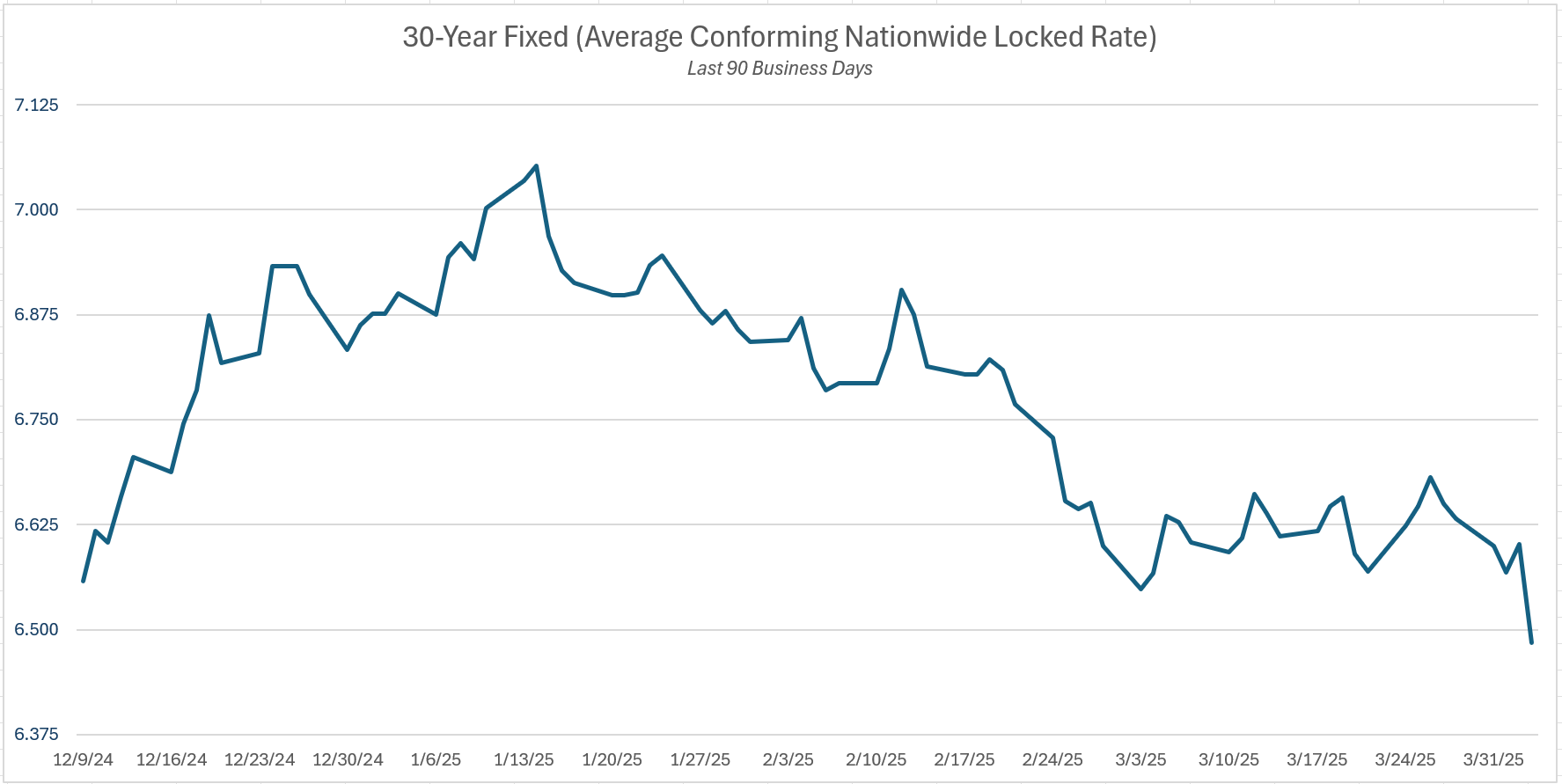
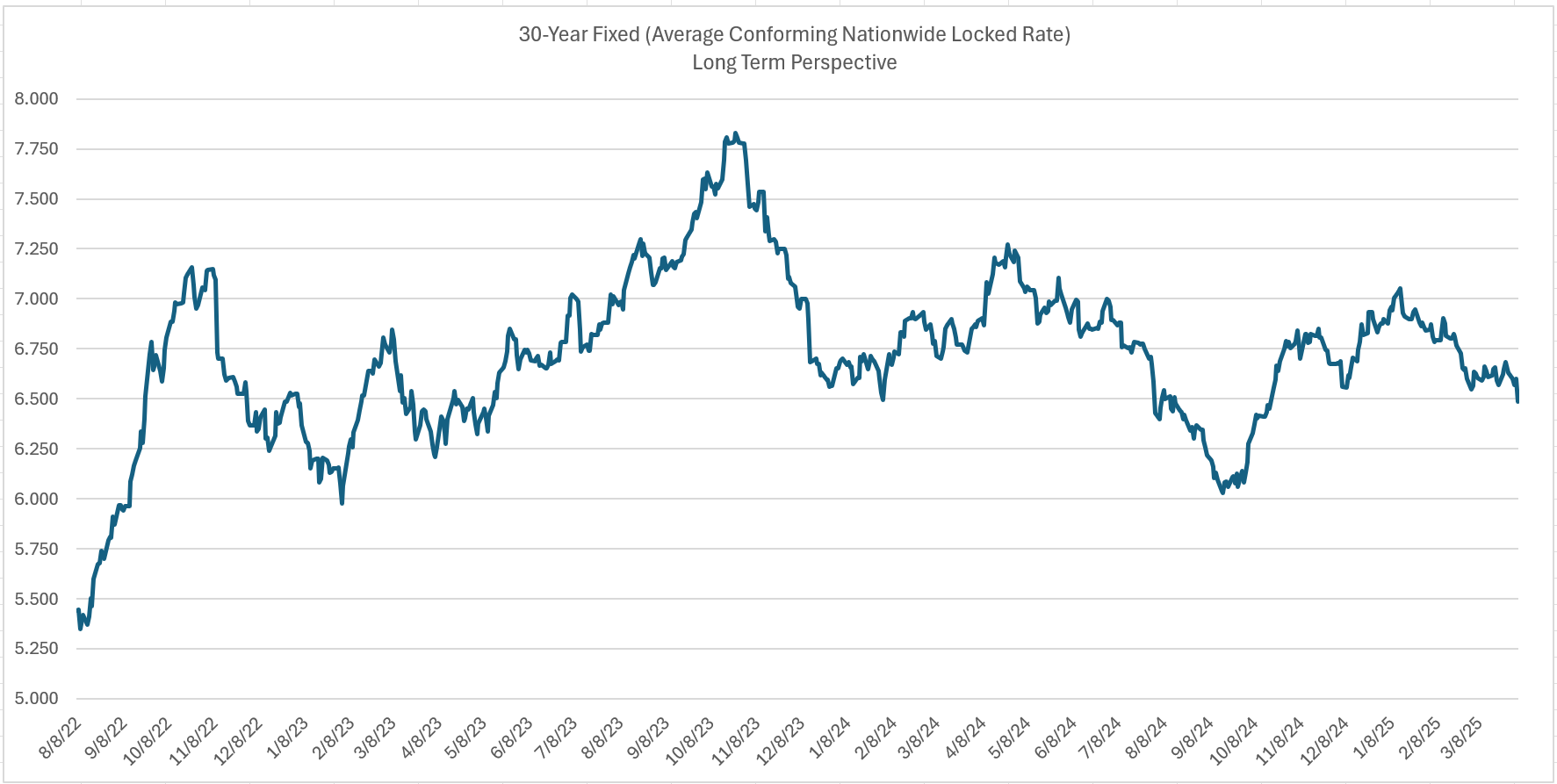
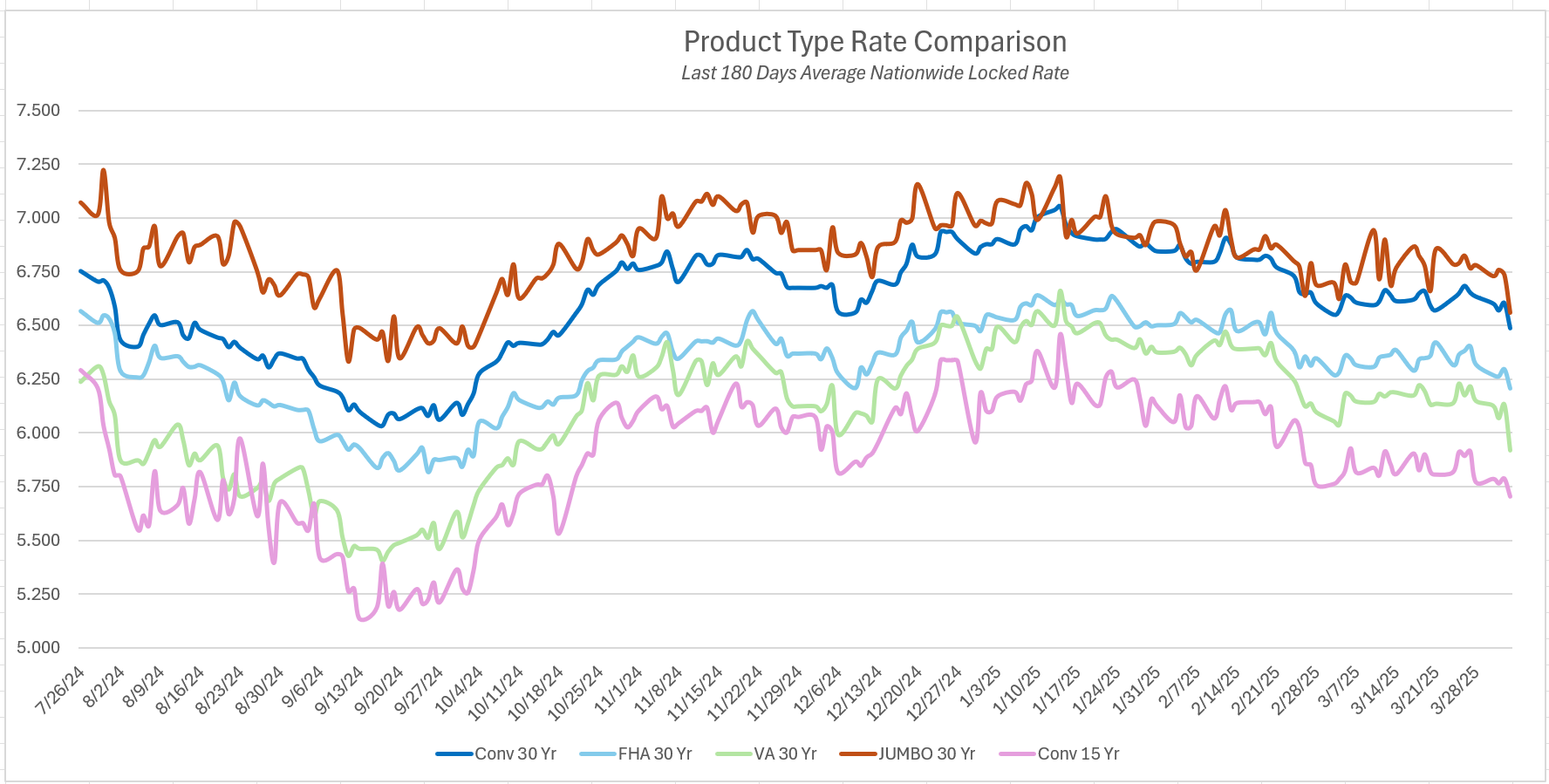
As of April 3rd, the average conventional 30-year rate for loans locked across the nation was 6.48%. (Note: this is for all lenders, not specific to Integrity Capital, whose rates are generally significantly lower than the average.) This is a 17 basis point decrease on a week-over-week basis. Volatility was at the highest level we have experienced in over a year.
Longer term loan products (i.e. 30-Year) declined comparatively more versus shorter terms (i.e. 15-Year). Moreover, adjustable rate loans did not drop as much as fixed rate products.
There is a high probability that volatility will continue to be elevated during the next couple weeks. Keep in mind that until a loan is locked, market fluctuations could cause rates to be better or worse, which affects the monthly payment and could therefore jeopardize an approval. Borrowers are recommended to take this into consideration when choosing when to lock in their rate.
|
|
|
|
|
|
|
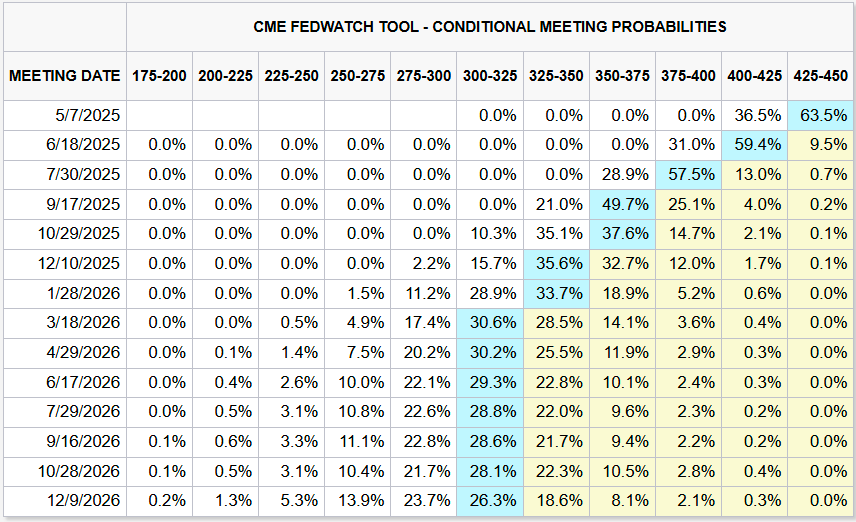
Next FOMC Meeting: Wednesday, May 7
Current Fed Funds Rate Range: 4.25% – 4.50%
As of today, financial markets are pricing in a 36.5% probability of a 25 basis point cut in the Fed Funds rate at the next Fed meeting. This is double last week’s comparable probability and reflects the market’s heightened concern of a slowdown in the economy. Looking further out to the June 18th FOMC meeting, the market is pricing in a 59% probability of a 25 basis point cut, and a 31% probability of a 50 basis point cut.
Key factors fueling this shift in probabilities include:
- Softening Economic Data: Last week’s weaker-than-expected jobs report and slower consumer spending figures hint at a cooling economy, prompting traders to bet on Fed easing to bolster growth.
- Inflation Trends: Inflation metrics showed stabilization, easing pressure on the Fed to maintain a hawkish stance.
- Global Uncertainty: Geopolitical tensions and softening global demand have bolstered the case for a dovish pivot, as the Fed weighs external risks to U.S. stability.
- Bond Market Signals: A drop in 10-year Treasury yields reflects investor flight to safety, aligning with expectations of lower rates ahead.
|
|
 |
|
|
 |
|
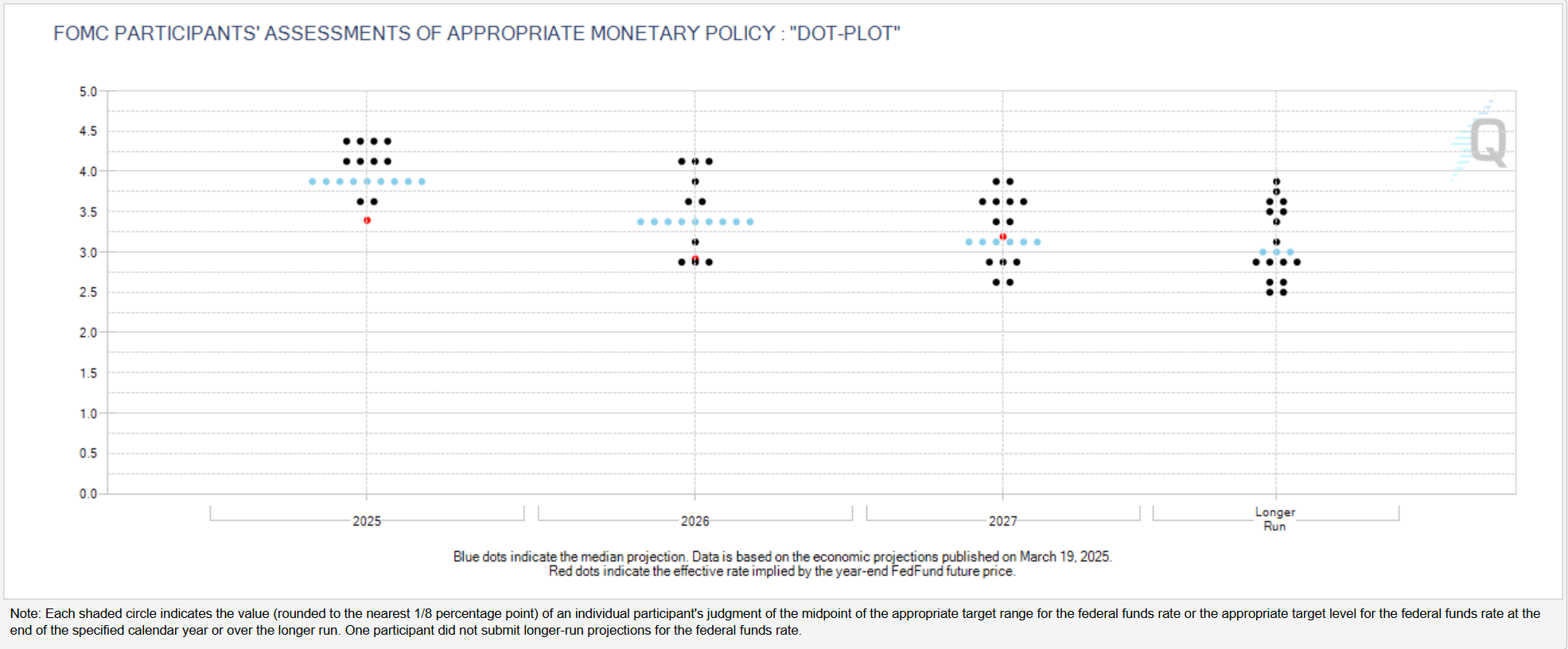
How to Read the Fed’s Dot Plot (chart below)
● Each dot represents one FOMC member’s forecast.
● There are 19 participants in the dot plot:
-
▪︎ 7 Fed Board Governors (nominated by the President and confirmed by the Senate
-
▪︎ 12 Regional Fed Bank Presidents
● The red dot shows the market’s forecast, based on the price where futures are trading.
● The blue dots represent the median forecast.
● The greater the dispersion in the dots, the less consensus between the partipants.
Usefulness for Borrowers: Provides an educated indication of where the Fed Funds rate may be in future years.
|
|
|
|
|
|
|
|
Question: Why should I stay abreast of upcoming economic news?
Answer: Financial markets react to disparities between expected versus actual economic data. On days where highly anticipated economic data is released there is a greater likelihood of heightened volatility (risk). This is particularly relevant if you are locking it a rate.
|
|
|
|
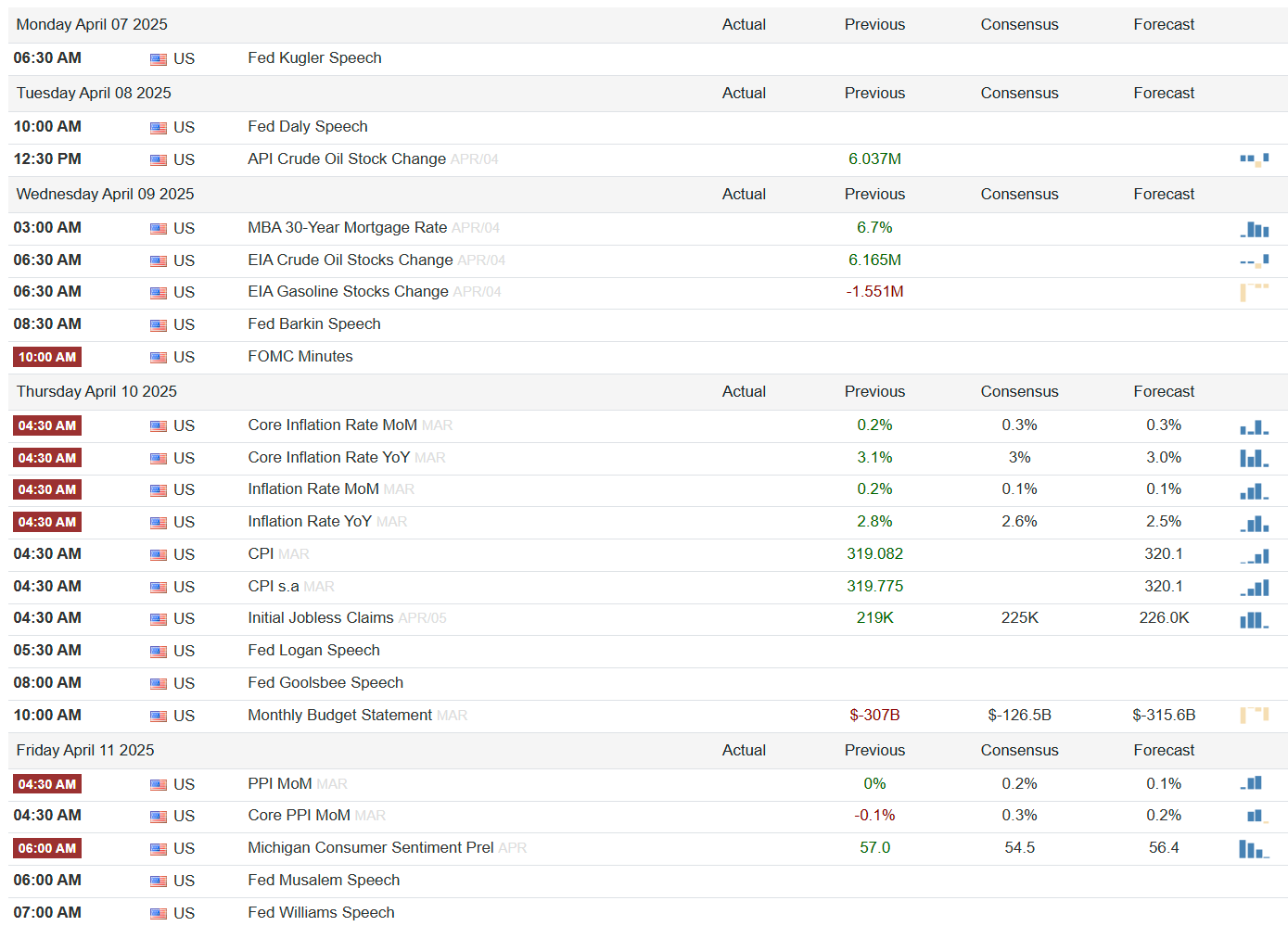
Here’s a rundown of this week’s key economic data being released — what’s coming & why it matters:
What: Consumer Price Index (CPI)
When: Thursday, April 10
Market’s Expectation: Headline CPI is forecast to rise 2.6% on a year-over-year, with core CPI (excluding food/energy) rising 3.0%.
What to Watch for: Hotter-than-expected inflation could spook bond markets, raising Treasury yields and mortgage rates. A cooler-than-expected CPI could provide further justification for a rate cut causing mortgage rates to decline further.
What: Jobless Claims
When: Thursday, April 10
Market’s Expectation: Initial claims are projected at 225K, up slightly from last week’s number of 219K.
What to Watch for: A spike in jobless claims could signal labor market cracks, thereby pressuring rates lower. Conversely, a drop in initial jobless claims could suggest the labor market is all rainbows and unicorns, resulting in a rise in mortgage rates.
What: Producer Price Index (PPI)
When: Friday, April 11
Market’s Expectation: The market is forecasting wholesale inflation (PPI) to edge up 0.2% month-over-month.
What to Watch for: PPI is a leading indicator for consumer prices. Thus, a big PPI surprise could foreshadow CPI trends, influencing lender pricing and rate volatility.
|
|
|
|
|
|
|
|
Myth: “It’s Best to Go With My Realtor’s Recommended Lender”
|
|
|
|
Reality: That referral might cost you thousands $$$ —and your realtor may have a financial incentive to steer you there.
Many buyers assume that if their realtor recommends a lender, it must be because they’re the best. But here’s what’s rarely said out loud: in many cases, that so-called “preferred lender” is paying to be recommended.
Behind the Scenes:
Realtors and lenders often have “preferred partner” arrangements—meaning the lender is covering the realtor’s online ads, print marketing, co-branded flyers, open house materials, or even sending mutual referrals.
This isn’t illegal, but it may not be the most ethical, – and it absolutely creates bias. It turns a “recommendation” into a “I’ll scratch your back” business partnership—and you, the buyer, are the one footing the bill through higher rates or fees.
Why This Hurts You:
- You’ll rarely get the best pricing. These lenders rely on referral volume, not razor-sharp rates, to keep their pipeline full. There’s less pressure for them to compete.
- Limited product access. The lender may not have the depth or flexibility of a broker or wholesale lender who can shop dozens of investors for your exact situation.
- Misaligned priorities. Your realtor wants a smooth, fast close—and that’s valid. But the lender they refer may be better at speed than saving you money. You need both.
- You give up your leverage. When you don’t shop, compare, or challenge the first quote, you’re often settling for retail pricing in a market where wholesale options exist.
Bottom Line:
Your home is likely the biggest financial investment you’ll ever make. Don’t outsource your mortgage to someone whose primary qualification is paying for a spot in your realtor’s phone.
Shop around. Ask questions. And work with a lender whose only loyalty is to you.
|
|
|
|
|
|
|
Insurance Shock: How California Homebuyers Are Feeling the Heat
When Is Insurance Required for Loan Approval?
If you’re buying a home with a mortgage, home insurance isn’t optional—it’s a non-negotiable hurdle to clear before your loan can close. Lenders require proof of coverage to protect their investment in your property. Typically, you’ll need a policy in place by the time you sign your final loan documents, with the first year’s premium often paid upfront at closing. For conventional loans, this means insuring at least the loan amount or the home’s replacement cost—whichever is higher. FHA and VA loans have similar mandates, though specifics vary. Without insurance, your lender won’t fund the deal, leaving you stuck at the finish line. For California in particular, securing a home insurance policy is proving tougher—and pricier—than ever.
The Premium Pain: How Much Have Costs Climbed?
Home insurance premiums in California have skyrocketed, hitting borrowers hard. Industry estimates suggest average annual premiums have jumped by 25%–40% since 2023, with some homeowners reporting increases as high as 50% in high-risk zones. For a typical $500,000 home, that translates to premiums rising from $1,200 to $1,800 annually—or even more in wildfire-prone areas like Sonoma or the Sierra foothills. In extreme cases, anecdotal reports peg costs at $3,000–$5,000 – and that’s if coverage is even still available. These figures substantially outpace national averages, where premiums have risen by 10%–15% over the same period, per the Insurance Information Institute.
Why Are Premiums Skyrocketing?
Several factors have collided to drive this trend:
- Wildfire Risk: The 2024 fire season, following years of devastating blazes, racked up billions in claims. Both the frequency and severity of claims has increased. Insurers have responded by pricing in higher expected losses.
- Reinsurance Costs: Global reinsurers, who backstop primary insurers, have hiked rates after massive payouts, passing costs down to California policyholders.
- Construction Inflation: Soaring lumber, labor, and rebuilding costs mean higher replacement values, boosting premiums to match.
- Regulatory Lag: California’s insurance market operates under strict rate-approval rules. Insurers argue these constraints limit their ability to adjust rates gradually, forcing bigger jumps when approvals finally come.
How Insurance Rates Are Set
Home insurance premiums aren’t arbitrary—they’re calculated based on risk models blending:
- Location: Proximity to fire zones, floodplains, or earthquake faults jacks up rates.
- Home Features: Age, materials (e.g., wood vs. brick), and upgrades like fire-resistant roofing influence costs.
- Claims History: Past payouts in your area—or on your property—signal higher risk.
- Coverage Levels: Replacement cost estimates, adjusted for inflation, set the baseline. Insurers then layer on profit margins and loss projections.
In California, the Department of Insurance must approve rate hikes, a process that can lag behind real-time risk shifts—leaving insurers scrambling when disasters pile up.
Impact on Borrowers and Approvals
Rising premiums are more than a mere budget annoyance—they’re reshaping the mortgage landscape:
- Affordability Squeeze: An extra $1,000/year in insurance tacks on $83/month to housing costs, pushing debt-to-income (DTI) ratios to higher levels, which could push it past lender’s eligibility thresholds. For a $600,000 loan at 6%, that’s like adding 0.2% to your rate.
- Loan Denials: Lenders won’t close without insurance. In areas where coverage is scarce—or unaffordable—deals collapse, stalling approvals.
- Cash Buyers Gain: Wealthier buyers who can skip financing and buy a property in cash, avoid the mandatory insurance requirement. Granted they a rolling the dice that a devastating event won’t happen! This grants them more flexibility with outbidding mortgage-dependent borrowers, especially in rural counties.
-
Insurers Fleeing the Golden State
Big names like State Farm, Allstate, and Farmers have either paused new policies or scaled back in California since 2023, citing unsustainable losses. State Farm, for instance, stopped writing new homeowner policies in mid-2023, pointing to wildfire exposure and regulatory hurdles. Smaller insurers have followed, leaving gaps filled by the California FAIR Plan—a costly, bare-bones state-backed option. FAIR Plan enrollment has spiked 50% in two years, but its limited coverage (e.g., no liability protection) leaves borrowers vulnerable—and lenders wary.
Looking Ahead: Prognosis for Borrowers
The future looks challenging but not hopeless:
- Short-Term Strain: Premiums will likely keep climbing through 2025 as wildfire risks persist and insurers recalibrate. Borrowers in high-risk zones might see costs double—or lose private options entirely.
- State Intervention: Lawmakers are mulling reforms, like speeding up rate approvals or expanding FAIR Plan scope. Progress is slow, though, and relief may not hit until 2026.
- Market Shifts: New insurers could enter if regulations ease, but climate trends might deter them. Borrowers may lean harder on mitigation—think firebreaks or metal roofs—to snag discounts.
- Borrower Strategy: Shop early, budget for steep premiums, and explore FAIR Plan as a last resort. In fire zones, locking in a policy before underwriting tightens further is key.
For California homebuyers, insurance isn’t just a checkbox—it’s a make-or-break factor. As costs rise and options shrink, planning ahead could mean the difference between closing the deal and watching it burn out.
|
|
|
|
|
|
|
|
|