
50-Year Mortgages: Facts vs. Fiction
Written by: Brian Tilton
I’ve received many calls and emails inquiring about President Trump’s recent mention of a 50-year mortgage. To help you stay informed, this article explains exactly what was said, who said it, whether such a loan actually exists today (spoiler: it doesn’t yet), and the real economics behind a 50-year mortgage. We’ll cover the advantages, drawbacks, likely interest-rate differences, the regulatory hurdles, and the role Fannie Mae and Freddie Mac would play. My goal is straightforward: to give you clear, unbiased facts so you and your family can make smart, informed decisions.
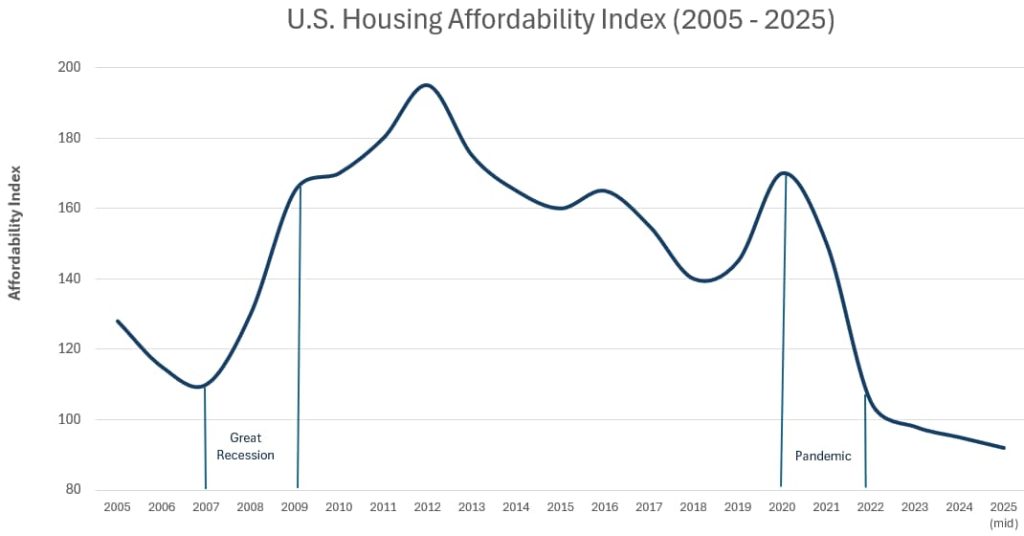
The Core Driver: America’s Home Affordability Crisis
The primary motivation behind President Trump’s 50-year mortgage idea is simple yet profound: restoring affordability to a housing market that has priced out millions of families, especially younger ones trying to buy their first home. For decades, homeownership has been the cornerstone of the American Dream and the greatest engine of middle-class wealth-building. But in recent years, a perfect storm of surging home prices, chronic underbuilding of new homes, and wage growth that hasn’t kept pace has pushed monthly payments to historic highs.
Nationally, the typical mortgage payments now consume 35-40% of median household income far above the prudent 28% – 30% guideline lenders recommend. This “payment shock” explains why home sales remain depressed despite a growing population and why so many millennials and Gen Z adults are delaying marriage, children, or staying with parents longer than previous generations.
The chart below illustrates the decline in national housing affordability over the past 20 years, using the National Association of Realtors’ Housing Affordability Index. An index of 100 means a median-income family has exactly the income needed to qualify for a median-priced home with 20% down and payments at 25% of income. Above 100 = more affordable; below 100 = unaffordable for the typical family.
What Did President Trump Say, and When?
The idea surfaced publicly on November 8, 2025, when President Trump posted a graphic on Truth Social titled “Great American Presidents.” It featured a photo of Franklin D. Roosevelt labeled with “30-Year Mortgage” a nod to FDR’s New Deal policies that popularized the 30-year fixed-rate loan in the 1930s to help Americans recover from the Great Depression and a photo of President Trump himself labeled “50-Year Mortgage.”
Shortly after, Federal Housing Finance Agency (FHFA) Director Bill Pulte, who oversees Fannie Mae and Freddie Mac, confirmed on X (formerly Twitter): “Thanks to President Trump, we are indeed working on The 50-Year Mortgage a complete game changer.” Pulte emphasized that this was part of a broader effort to improve affordability, particularly for younger buyers facing record-high home prices and mortgage payments that now eat up nearly 40% of median household income in many areas.
President Trump later described it in interviews, saying it would simply allow borrowers to “pay less per month” over a longer period and “might help a little bit.” The objective is to lower monthly payments and unlock homeownership for more families without requiring massive down payments or higher incomes.
While details remain light no formal legislation or timeline has been announced.
Advantages and Disadvantages for Borrowers: The Economics Explained
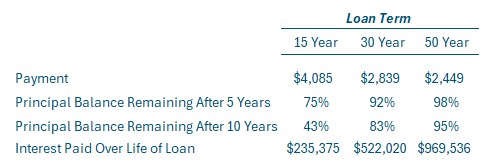
At its core, a mortgage is an amortization schedule: Your monthly payment covers interest plus a bit of principal, gradually building equity until the loan is paid off. Extending the term from 30 to 50 years spreads those principal repayments over more time, fundamentally changing the math. (The table shown below will be referred to in the examples given. A loan amount of $500K and a rate of 5.5% is assumed for discussion purposes.)
Advantages for Borrowers:
- Lower Monthly Payments: This is the headline benefit. By amortizing over 50 years instead of 30, the principal portion of each payment shrinks dramatically in the early years.
- Example: On a $500,000 loan at 5.5% interest (a realistic rate today), a 30-year mortgage requires $2,839 per month (principal and interest only). A 50-year version drops that to $2,449 a savings of $390 monthly, or $4,680 annually. For many families, that’s the difference between qualifying for a home or staying priced out.
- Improved Affordability and Qualification: Lenders use debt-to-income ratios to approve loans. Lower payments mean more borrowers especially first-time buyers or those in high-cost areas could qualify for larger loans without exceeding guidelines.
- Cash Flow Flexibility: That extra money each month could go toward retirement savings, education, emergencies, or even extra principal payments if you choose (most mortgages allow prepayment without penalty).
- Hedging Against Inflation: Over decades, wages tend to rise while fixed payments stay the same, making the mortgage feel “cheaper” in real terms later in life.
Disadvantages for Borrowers:
- Massively Higher Total Interest Paid: You pay interest on the outstanding balance for 20 extra years. In the example above, total interest on the 30-year loan is $522,020; on 50 years, it jumps to $969,536 nearly double.
- Slower Equity Buildup: Equity (your ownership stake) comes from paying down principal and home
appreciation.- After 5 years on a 30-year loan: ~8% of principal paid off.
- On a 50-year: Only ~2%.
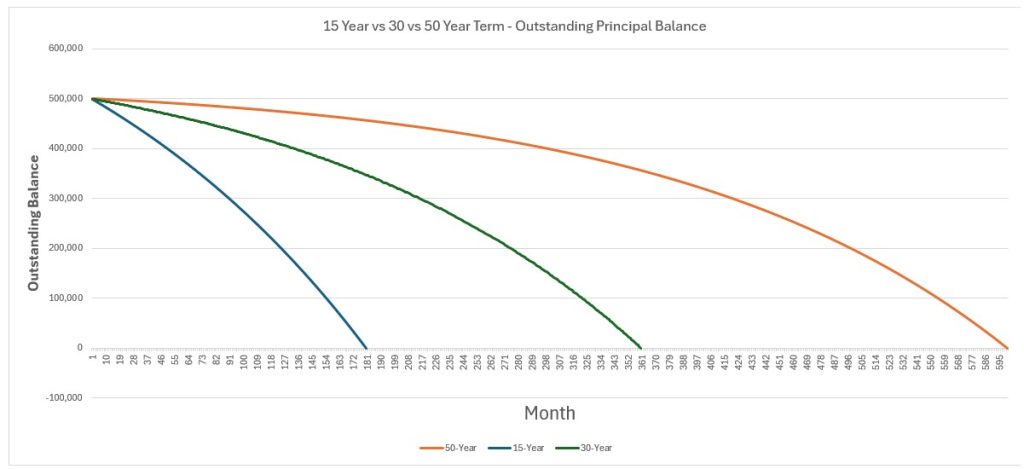
- After 10 years: 30-year borrowers have ~17% paid off; 50-year borrowers have just ~5%. This means less wealth-building through forced savings and vulnerability if home values dip you could owe more than the home is worth (underwater) for longer.
To better understand this point, refer to the chart below which shows the remaining loan principal balance percentage, by month, for a 15-Year, 30-Year, and 50-Year mortgage. While each product starts at 100% (i.e. the full balance), the shorter the term the faster equity in the home accumulates.
- Opportunity Cost and Long-Term Commitment: Money tied up in extra interest can’t compound elsewhere (e.g., stock market historically returns 7-10% annually). Plus, many buyers move or refinance every 7-10 years anyway, so the full 50-year term is rare but starting with slower equity still hurts.
- Potential for Higher Rates: As we’ll discuss next, longer terms often carry slightly higher interest rates due to added risk, eroding some payment savings.
Amortization Schedule Comparison:
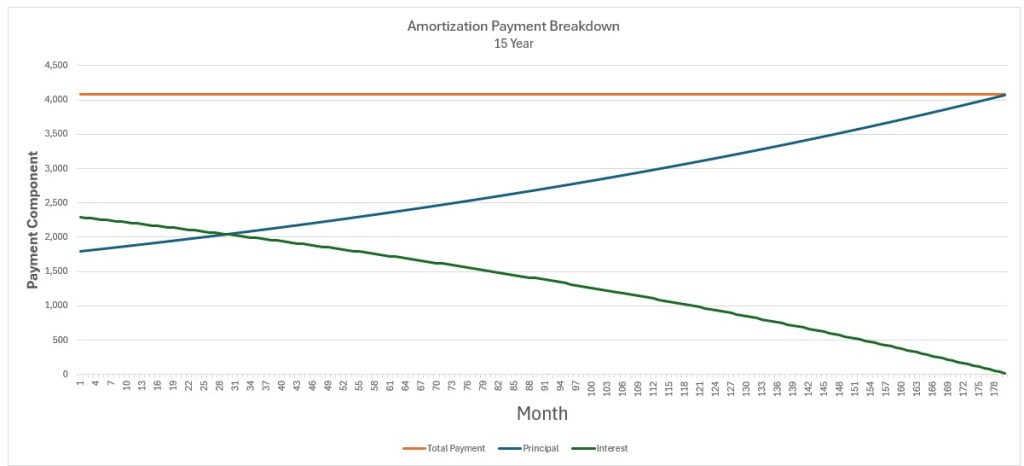
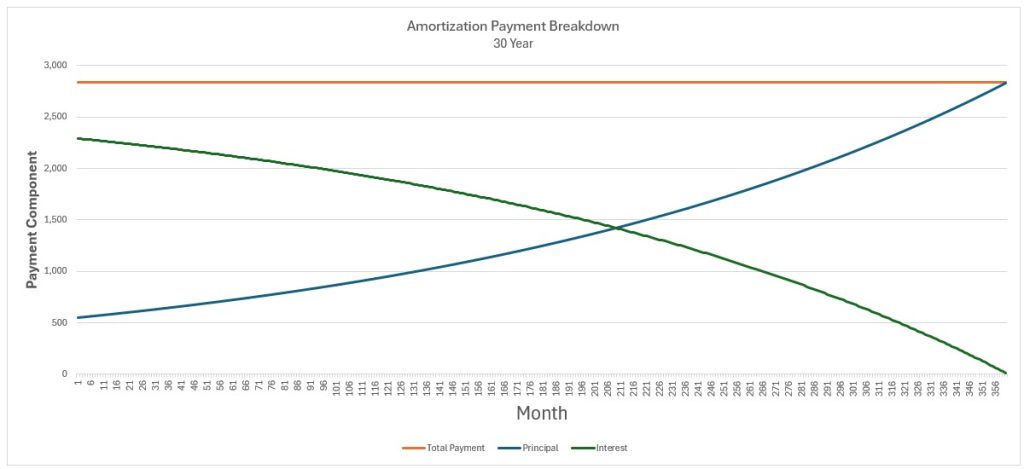
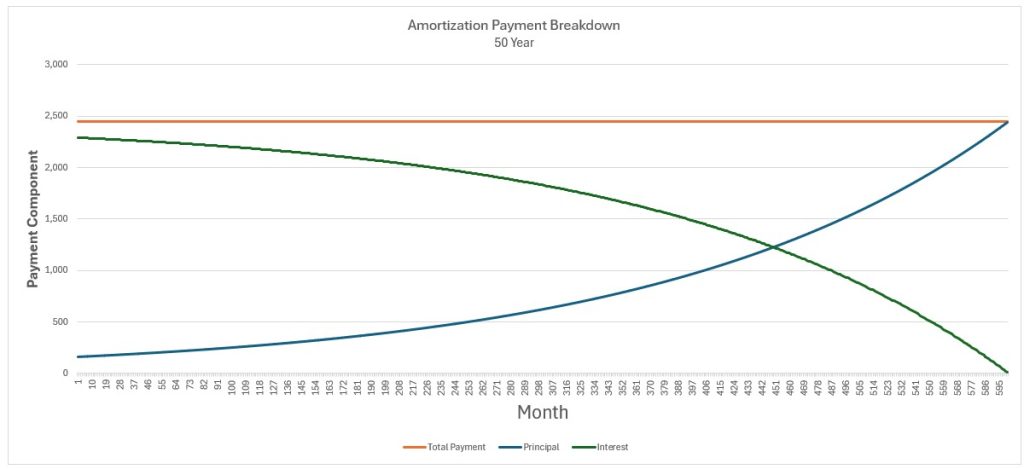
Looking at amortization charts makes the difference obvious: the longer the term, the smaller the portion going toward principal in the early years. On a 50-year mortgage, almost everything in the early years is interest.
Another insightful way of visualizing the differences between loan terms is viewing the amortization schedules. This shows the split between interest paid and principal paid for each month. Adding the interest portion plus the principal portion equals the total payment, which is the same every month. Referring to the diagrams below comparing 15 year, 30 year, and 50 year loan terms, the longer the term the smaller the amount applied to principal in the early years.
How Do Interest Rates on a 50-Year Mortgage Compare to a 30-Year?
While we don’t know exact rates yet, since a 50 year term does not currently exist, history and economics suggest a 50-year mortgage would carry a higher interest rate than today’s 30-year loans likely 0.5% to 0.75% higher.
Why? Mortgages are bundled into mortgage-backed securities (MBS) and sold to investors (pension funds, foreign governments, etc.). Investors demand
compensation for risk:
- Duration Risk (Interest Rate Risk): Longer terms mean money is tied up longer. If rates rise, the fixed payments become less attractive compared to new bonds. A 50-year bond has far higher “duration” (sensitivity to rate changes) than a 30-year.
- Prepayment Risk Uncertainty: Borrowers can refinance or sell anytime. Longer terms make prepayment patterns harder to predict, complicating investor hedging.
- Credit and Default Risk Over Time: Life happens job loss, health issues, economic downturns. The longer the loan, the more opportunity for default.
Demographic shifts (e.g., borrowers in their 40s today might face retirement challenges paying into their 80s or 90s) add uncertainty. - Inflation and Liquidity Risks: Investors prefer shorter horizons for flexibility.
We already see this today: 15-year mortgages often have rates 0.5% to 0.625% lower than 30-year because they’re less risky for investors.
Will This Become Available? Key Hurdles and Realistic Timeline
50-year mortgages are not coming tomorrow and they might never fully materialize in the way proposed.
Major hurdles include:
- Dodd-Frank and Qualified Mortgage (QM) Rules: Post-2008 reforms limit “qualified” mortgages (safe for lenders, eligible for Fannie/Freddie purchase) to 30-year terms max. Longer loans become “non-QM,” harder to originate, with higher rates and fewer buyers. This would require an act of Congress; and we all know how quickly this happens (cough, cough)
- Regulatory and Legislative Changes: FHFA could pilot through Fannie/Freddie (still in conservatorship), but widespread adoption likely requires
Congress amending Dodd-Frank or CFPB rules. Investor appetite for new 50-year MBS would need testing securitization markets hate unproven products. - Economic Stability Concerns: Regulators worry about systemic risks if millions take ultra-long loans during a downturn.
If pursued aggressively, a limited pilot via Fannie/Freddie could appear in late 2026 or 2027, but full availability might take years or fizzle if backlash grows. Borrowers: Don’t count on it soon.
Fannie Mae, Freddie Mac, and Government Loans: Where Does This Fit?
President Trump’s proposal appears targeted at conventional conforming loans backed by Fannie Mae and Freddie Mac not necessarily FHA, VA, or USDA government loans (though those could follow).
Fannie Mae (Federal National Mortgage Association) and Freddie Mac (Federal Home Loan Mortgage Corporation) are government-sponsored enterprises (GSEs) created by Congress. They don’t lend directly but buy mortgages from lenders, package them into mortgage-backed securities (MBS), guarantee timely payments, and sell to investors. This secondary market provides liquidity, keeping rates lower and terms standardized backing about half of America’s $12 trillion mortgage market.
Why are Fannie/Freddie rates lower than non-conventional (e.g., jumbo or portfolio) loans?
- Implicit (soon explicit?) Government Guarantee: Investors view them as ultra-safe since they are effectively backed by the government. Therefore, investors demand less yield premium.
- Scale and Standardization: Comparatively stricter underwriting (credit score, debt ratios, etc.) reduces defaults.
Non-conventional loans lack this implicit government backing, so investors require higher rates (often 0.5% to 1% more) for added risk.
A 50-year product would likely start as a Fannie/Freddie pilot to leverage their low-rate infrastructure for maximum affordability impact.
Final Thoughts
President Trump s 50-year mortgage proposal aims to address a real issue: affordability. For some buyers especially younger households or families stretched by today’s prices this type of loan could make the difference between owning a home and remaining on the sidelines. But it comes with real trade-offs: slower equity growth, higher lifetime interest costs, and higher rates than a standard 30-year loan.
As with any mortgage decision, the right choice depends on your goals. If your priority is qualifying with a lower payment, the longer term may help. If your
focus is building equity and minimizing borrowing costs, a shorter term remains the better option.
My advice: stay informed, evaluate all options, and make decisions based on your long-term financial plan not headlines. If you’d like to talk through how
different loan terms would affect your budget, qualification, or long-term wealth, I’m always here to help.

Website: https://IntegrityCapitalMortgage.com
Email: Brian@IntegrityCapitalMortgage.com
Phone: (888) 853-6390
NMLS #2613118