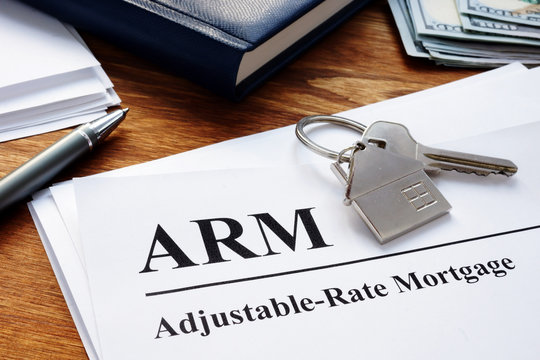
Adjustable Rate Mortgages (ARMs) often carry a stigma, largely due to their comparative complexity and a lack of understanding among borrowers. While ARMs can seem daunting, they can be a smarter choice than fixed-rate mortgages in many cases, depending on a borrower’s specific circumstances, current market conditions, and expectations for future interest rates. By gaining a clear understanding of ARMs, borrowers can confidently evaluate whether this mortgage product aligns with their financial goals, potentially unlocking significant savings and flexibility.
Introduction to ARMs
An Adjustable Rate Mortgage (ARM) is a home loan where the interest rate is fixed for an initial period and then adjusts periodically based on market conditions. Unlike fixed-rate mortgages, which maintain a constant rate for the entire loan term (typically 15 or 30 years), ARMs oƯer flexibility and potential savings, during the “fixed period” years. The trade-oƯ is uncertainty of future payments after the fixed period, which can rise or fall depending on economic trends.
ARMs are often appealing to borrowers who:
• Plan to sell or refinance their home within several years.
• Expect interest rates to remain stable or decline.
• Need lower initial payments to fit their budget.
However, the potential for rate increases makes ARMs riskier for homeowners who intend to hold the loan until maturity. Let’s do a deep-dive analysis into the details of how ARMs work and explore their key features.
Types of ARMs: 5/6, 7/6, 10/6, and More
ARM types are identified by two numbers, such as 5/6, 7/6, or 10/6, which describe part of their
structure:
- First Number: The duration of the initial fixed-rate period in years.
- Second Number: The frequency of rate adjustments after the fixed period, typically in
months or years.
The choice of which ARM variation best fits your needs depends on your financial goals and how long you plan to stay in your home. A 5/6 ARM oƯers a shorter fixed period with potentially lower initial rates, while a 10/6 ARM provides more stability before adjustments begin. The 6-month adjustment frequency (e.g., 5/6) means more frequent changes compared to annual adjustments (e.g., 5/1), which can aƯect payment predictability after the fixed period ends.
Structure of ARMs: Index, Margin, and Caps
ARMs are built on three core components that determine how the interest rate is calculated and
adjusted after the fixed period:
1. Index: A benchmark interest rate index that fluctuates based on market conditions. While the underlying index changes daily, a loan’s rate will only adjust after the fixed period and only at each adjustment frequency (every six months for Conventional loan and every 12 months for an FHA loan). Common indices include:
o Secured Overnight Financing Rate (SOFR): Standard for conventional products.
Replaced LIBOR in 2020 as a standard for conventional ARMs.
o 1-Year Constant-Maturity Treasury (CMT): Tied to U.S. Treasury securities. This is
the standard for FHA ARMs.
o Cost of Funds Index (COFI): Based on savings institutions’ borrowing costs. This is
less widely used.
Margin: A fixed percentage added to the index to set the future interest rate after the fixed period. For example, if the SOFR index is 3% and the margin is 2.5%, the ARM rate will adjust to is 5.5%. Margins remain constant for the life of the loan.
Caps: Limits how much the rate can increase or decrease at each adjustment, thereby limiting borrower and investor risk:
o Initial Cap: Limits the rate change at the first adjustment.
o Periodic Cap: Limits rate changes on each subsequent adjustment period.
o Lifetime Cap: Caps the total rate change over the life of the loan.
o Floor: Establishes the minimum rate over the life of the loan. The floor is generally equal to the margin.
In summary, after an ARM’s initial fixed period, the rate will adjust to the “fully-indexed rate”, which is the index value plus the margin, subject to the cap limits. A table describing the ARM structures for the primary product types is below.
Product Type
Fixed Period
(years)
Adjustment
Frequency
(months)
Index Margin Initial Rate
Change Cap
Periodic Rate
Change CapLifetime Rate Change CapConventional 5/6 5 6 SOFR 2.750% 2% 1% 5%Conventional 7/6 7 6 SOFR 2.750% 5% 1% 5%Conventional 10/6 10 6 SOFR 2.750% 5% 1% 5%FHA 5/1 5 12 CMT 1.750% 1% 1% 5%
Examples of ARM Rate Calculation
Suppose you have a 5/6 ARM with:
Initial rate: 5.25%
Margin: 2.75%
Caps: 2% initial, 1% periodic, 5% lifetime
Let’s assume that after the five year fixed period, SOFR is at 4.0%. The new fully-indexed rate will be 4.0% + 2.75% = 6.75%. The change between the current rate (5.25%) and the new rate (6.75%) falls below the 2% cap. Therefore the rate will adjust to 6.75%. Alternatively, if after 5 years, SOFR rises to 5.0%, the new fully-indexed rate is 5.0% + 2.75% = 7.75%. However, since 7.75% – 5.25% = 2.50%, which is greater than the 2% initial cap, the new rate will be capped at 7.25%; not 7.75%. The lifetime cap ensures the rate never exceeds 10.25% (5.25% + 5%).
When ARMs Make Financial Sense
ARMs can be a strategic choice in specific scenarios, but they require careful planning. Here’s
when they might work for you:
Short-Term Ownership: If you plan to sell or refinance within the fixed period (e.g., 5-10
years), you can benefit from the lower initial rate without facing a rate adjustment.
Expectation of Falling Rates: If you anticipate lower interest rates in the future, an ARM
could adjust to a lower rate, saving money compared to a fixed-rate mortgage.
Lower Initial Payments: ARMs’ lower introductory rates reduce early payments, helping
borrowers with tight budgets or those prioritizing other financial goals.
Financial Flexibility: If you can aƯord potential payment increases, an ARM’s initial
savings might outweigh future risks.
Comparing ARMs to Fixed-Rate Mortgages
The trade-oƯ between ARMs and fixed rate mortgages is essentially lower rates versus higher uncertainty. More specifically, during the initial fixed period, and possibly beyond, rates are generally lower, and therefore the payment is lower. However, as discussed earlier, after the initial fixed period, the loan’s rate will adjust to the fully-indexed rate, and depending on where the market is at that point in time, it could result in the rate adjusting higher, causing an increase in the payment. This uncertainty creates risk for borrowers who intend to keep the loan beyond the fixed
period.
When deciding between an ARM and a fixed-rate mortgage, a recommended strategy is to evaluate the cumulative ARM vs fixed-rate interest savings during the fixed period, and ask yourself if this amount justifies the future uncertainty. Additionally looking at the “optimal” time in years to refinance, based where the market is expecting future rates to be is a useful calculation. Moreover, evaluating your exposure at the worst-case scenario provides an indication of the maximum downside exposure a borrower faces. Integrity Capital Mortgage has proprietary models that calculate all of these statistics, and more. We are happy to evaluate your specific scenario, without any obligation.
Spreads (diƯerences) Between ARM and Fixed Rates
Are ARMs rates always more favorable than fixed rates? No, the comparative advantage or
disadvantage of ARMs vs fixed rates fluctuates substantially depending on economic conditions.
To understand why, we need to discuss the distinction between short-term and long-term interest
rates:
ARM Rates and Short-Term Indexes: As discussed earlier, ARMs are tied to short-term interest rate indexes, such as the Secured Overnight Financing Rate (SOFR) and the 1-Year Constand Maturity Treasury (CMT). These indexes reflect the cost of borrowing money in the short term—think months or a year. Because short-term rates are influenced by immediate economic conditions, like Federal Reserve policies or market liquidity, ARM rates can fluctuate frequently. For example, if the Fed raises its benchmark rate to cool inflation, short-term indexes like SOFR often rise, pushing ARM rates up.
30-Year Fixed Rates and Long-Term Rates: In contrast, 30-year fixed-rate mortgages are pegged to long-term interest rates, often tied to the 10-year U.S. Treasury note. These rates reflect market expectations for economic conditions over decades, including GDP growth, inflation, and stability. Because they’re locked in for 30 years, fixed rates are generally higher than initial ARM rates to account for the lender’s long-term risk and uncertainty
about the future.
The spread between ARM and fixed rates exists because short-term and long-term rates respond diƯerently to economic signals. When short-term rates are low (say, during a recession), ARMs often start with lower rates than fixed mortgages, making them attractive. But when short-term rates rise, ARMs can adjust upward, sometimes surpassing fixed rates.
The Yield Curve: A Roadmap for ARM vs Fixed Rates Spreads
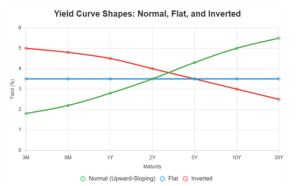
The yield curve is a powerful tool for understanding why ARM and fixed rates diƯer. It’s a graph plotting interest rates (yields) against the time to maturity for U.S. Treasury securities, from short- term (like 3-month T-bills) to long-term (like 30-year bonds). The shape of the yield curve tells us how the market views the future economy and inflation expectations, and it directly impacts mortgage rates.
Normal (Upward-Sloping) Yield Curve: In a healthy economy, the yield curve slopes upward, meaning long-term rates are higher than short-term rates. Why? Investors expect higher returns for tying up their money longer, as there’s more uncertainty over time (e.g., inflation or economic shifts). In this scenario, 30-year fixed mortgage rates are typically higher than initial ARM rates, creating a wider spread. For borrowers, this makes ARMs appealing if you plan to sell or refinance before the rate adjusts.
Flat Yield Curve: When short-term and long-term rates are close, the yield curve flattens. This often happens when the economy is in transition—say, the Fed is raising short-term rates to curb inflation, but long-term rates stay steady due to cautious growth expectations. Here, the spread between ARM and fixed rates narrows, making fixed rates more competitive if you value stability.
Inverted Yield Curve: In rare cases, short-term rates exceed long-term rates, signaling investor concerns about a potential recession. An inverted curve can shrink or even reverse the ARM-fixed spread, where initial ARM rates might be higher than fixed rates. This scenario warns borrowers that ARM rates could climb further after adjustments. It is noted that between 2023 and early 2025 the yield curve was inverted and therefore it was not advantageous to select an ARM. However, during the last couple months conditions have changed,
A hypothetical example of each of these curves is presented below.
Recap:
Before choosing an ARM, consider these factors:
Understand the Terms: Review the index, margin, and caps. Compare lenders as their
rates vary considerably. Select a lender that is an advocate for your best interest.
Refinancing Options: Plan for refinancing by the end of the fixed period if rates rise.
Depending on where rates are after the fixed period, it will be beneficial to delay
refinancing, but its prudent to assume you will.
Economic Environment: Monitor inflation, Federal Reserve policies, and economic
growth, which influence rates (Morningstar).
Time Horizon: As a general rule, ARMs are best suited for short-term plans (e.g., 5-10
years, depending on the fixed period selected). For borrowers who intend to keep a
mortgage until maturity a fixed-rate has reduced risk and may be more suitable.
Conclusion
Adjustable Rate Mortgages oƯer a compelling option for borrowers seeking lower initial payments, particularly those with short-term ownership plans, plans to refinance, or confidence in falling rates. However, their variable nature requires careful consideration of risks, including potential rate hikes and payment uncertainty if held beyond the fixed period. By understanding ARMs’ structure, comparing them to fixed-rate mortgages, and aligning your choice with your financial goals, you can make a decision that suits your needs. We realize there is a lot of information contained here and it might be overwhelming. Integrity Capital Mortgage is happy to assist with answering any questions you may have, regardless of whether you select us as your lender or you go with an alternative lender. Moreover we are happy to run the numbers through our proprietary model to quantify whether an ARMs’ savings justifies the higher future uncertainty. With the right strategy, an ARM could be a powerful tool to save you thousands of dollars in interest and oƯer you lower payments to achieve your homeownership dreams.