As you plan your housing future in 2025, the decision to rent or buy is more complex than ever. Rising rents, fluctuating mortgage rates, and shifting market conditions—driven by economic policies like tariƯs and evolving inflation trends—make it critical to weigh your options carefully. This article breaks down the financial and lifestyle factors to help you decide which path oƯers the most value, with practical tools and insights to guide your choice. Whether you’re a first-time homebuyer, a renter seeking stability, or someone reassessing your housing strategy, you’ll walk away with actionable steps to make an informed decision. At Integrity Capital Mortgage, we’re here to provide personalized guidance to help you navigate this choice with confidence, oƯering free consultations to explore your options without pressure.
The Big Picture: Housing Costs in 2025
The housing market in 2025 is shaped by several key trends:
Rising Rents: According to Zillow, average U.S. rental prices have increased 4.2% yearover-year, with median monthly rents reaching $2,050 for a two-bedroom home as of May
2025.
Mortgage Rates: The 30-year fixed mortgage rate hovers around 6.5–6.8% (nationally reported rate), influenced by the Federal Reserve’s steady federal funds rate (4.25%– 4.50%) and tariƯ-driven inflation concerns.
Home Prices: Median home prices are up 3.8% to $425,000, driven by low inventory and rising construction costs.
Economic Context: TariƯs, implemented in early 2025, have increased construction material costs, pushing new home prices higher. The Fed’s cautious stance, with two projected rate cuts later in 2025, suggests mortgage rates may remain elevated in the near term, though experience a declining trend looking further out.
These factors create a challenging environment for both renters and buyers, but a detailed cost
comparison can reveal which option better suits your financial goals.
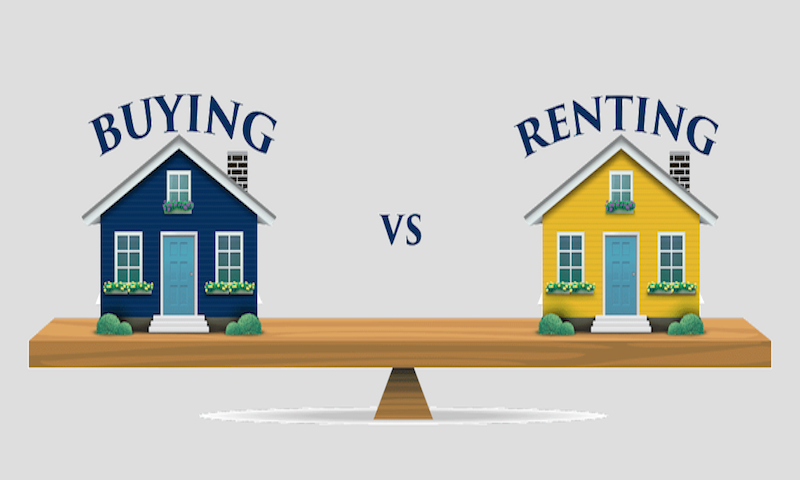
Cost Comparison: Renting vs. Buying
To determine cost-eƯectiveness, let’s analyze a hypothetical scenario for a two-bedroom home in
a mid-sized U.S. city in 2025, using national averages.
Renting Costs
Monthly Rent: $2,050 (national median for a two-bedroom apartment).
Renter’s Insurance: $15–$20/month ($18 average).
Upfront Costs: Security deposit (typically one month’s rent, $2,050) and potential broker
fees ($500–$1,000).
Annual Cost: $2,050 × 12 + $18 × 12 = $24,816, excluding upfront costs.
Hidden Costs: Rent increases (4–5% annually) and limited control over maintenance or
property decisions.
Buying Costs
Home Price: $425,000 (median single-family home).
Mortgage Payment: For a $425,000 home with a 20% down payment ($85,000) and a 30-
year fixed mortgage at 6.7%, the monthly payment is approximately $2,250 (principal and
interest).
Additional Costs:
o Property taxes: $4,250/year (1% of home value, national average).
o Homeowners insurance: $1,500/year ($125/month).
o Maintenance: $4,250/year (1% of home value, industry rule of thumb).
o Private Mortgage Insurance (PMI): $0 (avoided with 20% down).
Monthly Cost: $2,250 (mortgage) + $354 (taxes) + $125 (insurance) + $354 (maintenance) =$3,083.
Annual Cost: $3,083 × 12 = $36,996.
Upfront Costs: Down payment ($85,000), closing costs (2–5% of home price, ~$8,500–
$21,250), and moving expenses (~$1,000).
Hidden Benefits: Potential home appreciation (3–5% annually) and tax deductions for mortgage interest and property taxes.
Break-Even Analysis
Renting is cheaper upfront and monthly ($2,068 vs. $3,083), but buying builds equity and oƯers potential appreciation. To break even, consider the break-even point—the time it takes for buying to become more cost-eƯective than renting due to equity growth and tax benefits.
Annual Cost DiƯerence: $36,996 (buying) – $24,816 (renting) = $12,180.
Equity Build-Up: In year one, ~$6,000 of mortgage payments go toward principal
(amortization schedule). Assuming 3% annual appreciation ($12,750), total equity gain is
~$18,750.
Tax Benefits: Mortgage interest (~$22,000 in year one) and property taxes ($4,250) may yield $5,000–$7,000 in tax savings (depending on tax bracket).
Net Cost of Buying: $36,996 – $18,750 (equity) – $6,000 (tax savings, midpoint) = $12,246.
Break-Even Point: The costs are nearly equal in year one ($12,246 vs. $12,180). Over 5–7
years, buying typically becomes more cost-eƯective if home values rise and rent increases
continue.
Key Takeaway: Renting is more cost-eƯective for short-term stays (1–3 years) or if you lack down payment savings. Buying makes sense for longer-term plans (5+ years) in markets with stable appreciation. Integrity Capital Mortgage can help you run a personalized break-even analysis to see how these numbers apply to your situation—just reach out for a no-obligation consultation.
Long-Term Benefits of Buying
While renting oƯers short-term flexibility, buying a home in 2025 can provide significant long-term advantages, especially if you plan to stay put for a decade or more:
Wealth Building Through Equity: Each mortgage payment reduces your loan balance, increasing your ownership stake. Over 10 years, assuming a $425,000 home at 6.7% with a 20% down payment, you’d build ~$80,000 in principal equity, plus potential appreciation (e.g., $127,500 at 3% annual growth). This equity can be tapped later via home equity loans or used when selling.
Hedge Against Rent Inflation: Rent increases of 4–5% annually can outpace inflation, doubling costs over 15–20 years. A fixed-rate mortgage locks in your housing payment, shielding you from rising costs. For example, a $2,050 rent today could reach $3,300 by
2035 at 4.5% annual increases.
Retirement Planning: Owning a home outright by retirement eliminates housing payments, reducing your cost of living. Renters face ongoing payments, which can strain fixed incomes.
Legacy Creation: A home can be passed to heirs, providing generational wealth or a family asset, unlike renting, which oƯers no residual value.
Community Investment: Homeownership ties you to a community, fostering social and economic stability, which can provide lifestyle benefits.
Lifestyle and Financial Considerations
Beyond dollars and cents, your decision hinges on lifestyle and financial priorities:
Advantages of Renting
Flexibility: Easier to relocate for jobs or lifestyle changes.
Lower Upfront Costs: No need for a large down payment or closing costs.
Predictable Expenses: No maintenance or repair costs, though rent hikes are possible.
Best For: Young professionals, those in transitional phases, or anyone prioritizing mobility.
Advantages of Buying
Equity Building: Payments contribute to ownership and potential wealth growth.
Stability: Fixed-rate mortgages oƯer predictable payments, unlike rising rents.
Personalization: Freedom to customize your home.
Best For: Families, those planning to stay 5+ years, or anyone seeking long-term financial
benefits.
Risks to Consider
Renting Risks: Annual rent increases can erode savings, and you miss out on equity growth. Eviction risks or landlord decisions can disrupt stability.
Buying Risks: Home values may stagnate in some markets, and unexpected maintenance costs can strain budgets. Job loss or relocation could complicate things.
Practical Steps to Decide
To choose between renting and buying, follow these actionable steps:
1. Assess Your Timeline: If you plan to stay 1–3 years, renting is likely cheaper. For 5+ years, buying may save money long-term.
2. Calculate Your Budget: Use an online rent-vs-buy calculator, such as the one on the Integrity Capital Mortgage website, to compare costs based on your local market. Include all costs, like maintenance and taxes.
3. Check Your Finances: For buying, aim for a 20% down payment to avoid PMI, a debt-toincome ratio below 43%, and a credit score of 620+ for better rates.
4. Research Local Markets: Compare rent and home price trends in your area. Markets with high rent growth favor buying; stable home prices favor renting.
5. Consider Lifestyle: Value flexibility? Renting may suit you. Crave stability and personalization? Buying aligns better
Key Takeaways for 2025
Short-Term: Renting is more cost-eƯective for stays under 3 years due to lower upfront and
monthly costs.
Long-Term: Buying becomes cheaper after 5–7 years, oƯering equity, tax benefits, and protection against rent hikes, plus wealth-building opportunities over decades.
Market Context: Rising rents and home prices make buying attractive in high-growth areas, budget expected expenses for both scenarios.
Personalized Decision: Your choice depends on financial readiness, lifestyle goals, and local market trends.
At Integrity Capital Mortgage, we believe in empowering you with the knowledge and tools to make
the best housing decision. Whether you’re leaning toward renting or buying, our team is happy to
answer any questions you may have.