


FOMC Holds Fed Funds Rate Steady – What It Means for Mortgage Rates
This week, the Federal Open Market Committee (FOMC) announced its decision to keep the federal funds rate unchanged. For borrowers, this might seem like a non-event at first glance—after all, rates didn’t move. But the financial markets, including mortgage rates, don’t just react to what happens today; they’re forward-looking, pricing in expectations for the future. Let’s break down what influenced this decision, what the Fed hinted about next steps, and how it’s impacting mortgage rates.
Why the Fed Stayed Put
The FOMC’s decision to hold rates steady reflects a balancing act. Inflation has cooled somewhat but remains above the Fed’s 2% target, while economic growth continues at a moderate pace and the labor market shows resilience. The committee likely saw no urgent need to adjust policy, opting instead to monitor incoming data—like consumer spending, job reports, and global economic trends—before making a move. Essentially, they’re playing it cautious, avoiding over-tightening that could stall growth or easing too soon and reigniting inflation.
What They Said About the Future
In their statement and press conference, Fed officials emphasized a “data-dependent” approach. They hinted that rate cuts could come later in 2025 if inflation trends lower—some market analysts are penciling in expectations for two additional cuts before year-end—but they also left the door open for hikes if price pressures pick up. This uncertainty keeps markets on edge, as any shift in tone could signal a pivot. For now, the Fed’s message is clear: no big changes yet, but they’re watching closely.
The Market’s Reaction and Mortgage Rates
Here’s where it gets interesting. Mortgage rates didn’t stay flat just because the fed funds rate did. The 10-year Treasury yield, which heavily influences 30-year fixed mortgage rates, moved based on how the market interpreted the Fed’s stance relative to what it expected. If traders anticipated a rate cut and didn’t get it, yields (and mortgage rates) might tick up. If the Fed’s caution matched forecasts, the reaction might be muted. This forward-looking nature means mortgage rates often shift before the Fed actually acts—it’s about the signal, not just the decision.
Why Long-Term Rates Care About a Short-Term Rate
You might wonder: the fed funds rate is an overnight rate banks charge each other, so why does it affect 30-year mortgages? The connection isn’t direct but powerful. The Fed’s actions shape expectations for inflation and economic growth, which drive long-term bond yields like the 10-year Treasury. When the Fed holds steady or signals future moves, investors adjust their bets on where the economy’s headed. Higher yields push mortgage rates up; lower yields pull them down. It’s a chain reaction—short-term policy ripples into long-term borrowing costs.
What This Means for You
Mortgage rates remain sensitive to Fed signals and economic data. If you’re in the market for a home or refinance, keep an eye on upcoming inflation reports and Fed meetings. The market’s forward-looking lens means rates could shift even if the Fed doesn’t. As your broker, I’m here to help you navigate these changes and lock in the best rate when the timing’s right.
Interest Rate Trends
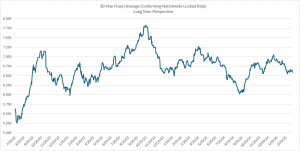
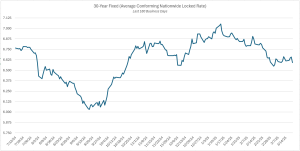
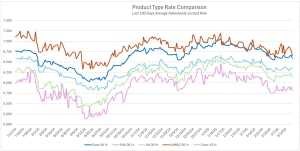
As of March 20th, the average conventional 30-year rate for loans locked across the nation was 6.569%. (Note: this is for all lenders, not specific to Integrity Capital, whose rates are generally significantly lower than the average.) This is a 7 basis point decrease in the rate average on a week-over-week basis. As a sidenote, there are 100 basis points in 1%. Therefore, 7 basis points is equivalent to 0.07% in rate. During the first half of the week rates rose (worsened), while in the second half rate declined (improved). Factors impacting this include the following:
Fed’s FOMC Decision and Commentary: Discussed in detail above.
Economic Data Releases: Midweek reports added fuel to the fire. February’s Consumer Price Index (CPI) came in slightly hotter than anticipated, showing a 2.8% year-over-year increase, reinforcing inflation concerns. Meanwhile, a stronger-than-expected retail sales report (+0.6% month-over-month) signaled robust consumer spending, hinting the economy might not need Fed relief anytime soon. Both nudged bond yields and mortgage rates upward.
Market Sentiment: Beyond the data, investor sentiment played a role. The FOMC’s signal of patience clashed with some traders’ hopes for dovish hints, prompting a sell-off in Treasuries. Mortgage-backed securities followed suit, with spreads holding steady but yields creeping higher. It’s a classic case of markets reacting not just to the news, but to how it stacked up against expectations.
Fed Watch

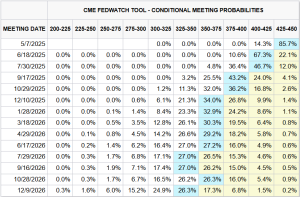
With the federal funds rate still unchanged after the March 20th meeting, borrowers are eager to know: will the Fed finally cut rates in May? As of today, financial markets are pricing in a 14.3% probability of a 25 basis point cut. Therefore an 85.7% probability of no change in rates at this meeting.
Looking further out to the June 18th FOMC meeting, the market is pricing in a 67% probability of a 25 basis point cut, and a 10.6% probability of a 50 basis point cut.
Factors that will drive the decision — and what you should watch closely in the weeks ahead.
Inflation Trends: The Fed has made it clear they want inflation firmly on track toward their 2% target before easing policy. March’s data showed consumer prices still hovering near 2.8%, and the upcoming March 27 PCE report (the Fed’s preferred gauge) will set the tone. If core PCE drifts closer to 2% by April—say, 2.5% or lower—it could build a case for a May cut. Persistent readings above 2.7%, however, might keep the Fed on hold.
Labor Market Cooling: The Fed’s dual mandate includes maximum employment, and they’re watching for signs the job market is softening enough to warrant relief. April’s jobs report (due early May) will be pivotal. A rising unemployment rate (e.g., from 4.1% to 4.3%) or weaker job growth (under 150,000 new jobs) could signal it’s time to ease. If hiring stays robust, the Fed might see no rush to cut.
Economic Growth Signals: Recent retail sales strength suggests the economy’s humming along, but any cracks—think weaker GDP forecasts or declining consumer confidence—could tip the scales. The Fed doesn’t want to choke growth with high rates, so evidence of a slowdown by late April might greenlight a cut.
“Fed Speak”: Between now and May, comments from Fed Chair Jerome Powell and other officials will drop clues. If they start sounding dovish—hinting at “easing conditions” or “progress on inflation”—markets might price in a May cut, pulling mortgage rates down ahead of time.
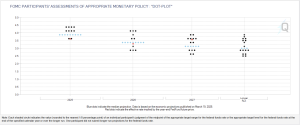
By the end of 2025, there is a 28% probability the fed funds rate will be at least 100 basis points lower!
Next FOMC Meeting: Wednesday, May 7
Current Fed Funds Rate Range: 4.25% – 4.50%
Why Does This Matter to Me A Borrower?
A May rate cut—say, 25 basis points—won’t directly slash 30-year mortgage rates, but it will ease the 10-year yield, potentially trimming mortgage rates by 0.1% to 0.25% over time. More importantly, it’d signal the Fed’s ready to pivot, boosting confidence for homebuyers and refinancers. But if the Fed holds firm, rates could stay elevated—or climb if inflation surprises higher.
For now, patience is key. The next six weeks of data will tell the story. If you’re planning a move, let’s keep a close eye on these indicators together. A well-timed lock could save you thousands—reach out, and we’ll strategize as May nears!
Economic Calendar
Question: Why should I stay abreast of upcoming economic news?
Answer: Financial markets react to disparities between expected versus actual economic data. On days where highly anticipated economic data is released there is a greater likelihood of heightened volatility (risk). This is particularly relevant if you are locking it a rate.
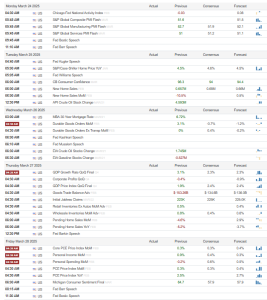
Spring’s heating up, and so is this week’s economic calendar! Here’s a rundown of the key items — what’s coming & why it matters:
When: Monday, March 24: New Home Sales
What’s Happening: February’s new home sales data lands, with estimates around 675,000 units annualized—a respectable, if uninspired, figure.
Why It Matters: A stumble below 650,000 might suggest buyers are ghosting the market, nudging Treasury yields—and mortgage rates—downward. A surge could keep rates aloft, signaling demand’s still got legs.
When: Wednesday, March 26: Jobless Claims
What’s Happening: Weekly initial jobless claims drop, following last week’s 215,000—a number so steady it’s practically meditative.
Why It Matters: A spike past 230,000 could hint the labor market’s fraying, tempting the Fed with rate-cut thoughts and softening yields. Flat or lower keeps the “all’s well” chorus humming, propping rates up.
When: Thursday, March 27: PCE Inflation Report
What’s Happening: February’s Personal Consumption Expenditures (PCE) index, the Fed’s golden child, arrives. Core PCE’s lingering near 2.8%—a thorn in the 2% target’s side.
Why It Matters: A slide toward 2.6% could stoke 2025 cut hopes, tugging yields and mortgage rates lower. A stubborn 2.8% or more might lift rates, as markets sigh over inflation’s tenacity.
When: Friday, March 28: Consumer Sentiment
What’s Happening: The University of Michigan’s final March consumer sentiment index closes the week, after a mid-month 76.5—cheerful, but not exactly exuberant.
Why It Matters: A dip below 75 could flag a consumer retreat, hinting at slower growth and lower rates. A climb past 78 suggests wallets are still open, keeping rates steady or up.
Mortgage Myths

Myth: “It Always Makes Sense Paying Off Your Mortgage Early”
For years, conventional wisdom has held that paying off your mortgage as fast as possible is the ultimate financial goal. It’s an appealing idea—owning your home outright, free of monthly payments. But is it always the best move? Not necessarily. Let’s debunk this myth and explore why keeping a mortgage might make sense for some borrowers.
The Case for Paying Off Early
The argument for early payoff is straightforward: eliminate debt, reduce interest costs, and gain peace of mind. If you’ve got a 6% mortgage and extra cash, sending it to the lender saves you that 6% in interest over time. It’s a guaranteed return, and for risk-averse folks or those nearing retirement, that security can feel priceless.
Why It’s Not Always a Slam Dunk
But here’s the flip side: money paid to your mortgage is money you can’t use elsewhere. Mortgage rates today, especially for those locked in below 4% from a few years ago, are historically low. Compare that to what you could earn investing in the stock market, where long-term average returns hover around 7-10% before inflation. If your mortgage rate is 3.5% and you could net 7% elsewhere, you’re potentially leaving money on the table by prepaying.
After-Tax Returns vs. After-Tax Costs
Here’s a key nuance: it’s not just the raw mortgage rate or investment return that matters—it’s the after-tax numbers. Mortgage interest is often tax-deductible, which lowers your effective borrowing cost. For example, if you’re in the 24% tax bracket and pay 4% interest, your after-tax cost drops to about 3% (4% x (1 – 0.24)). Meanwhile, investment returns—like stock gains—are typically taxed, reducing your net return. If that 7% market return shrinks to 5.5% after taxes, the gap narrows, but it still might beat your after-tax mortgage cost. This tax lens is critical to making an apples-to-apples comparison.
Liquidity and Inflation Benefits
Liquidity matters too. Tying up cash in home equity reduces your flexibility for emergencies, opportunities, or other goals like funding education or starting a business. And don’t forget inflation—it erodes the real value of your mortgage debt. If you borrowed $300,000 ten years ago, that amount feels smaller today because prices (and hopefully your income) have risen. Fixed payments get “cheaper” over time, while investments might grow with inflation. Prepaying trades away this advantage.
What’s Right for You?
There’s no one-size-fits-all answer. If you value debt freedom and sleep better without a mortgage, extra payments might be your path. But if you’re comfortable with debt, have a low rate, and see better after-tax returns elsewhere, letting your mortgage ride could build more wealth long-term. I’m happy to run the numbers with you—your rate, tax situation, and goals—to find the strategy that fits.
Housing Corner
This week, let’s zoom in on two housing market metrics that matter to borrowers: U.S. existing home sales and California active listings. These numbers tell us where the market’s been—and where it might be headed. Here’s the scoop, plus what it could mean for home shoppers.
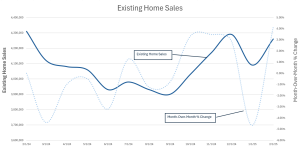
U.S. Existing Home Sales:
Latest Numbers: The National Association of Realtors reported February 2025 existing home sales at 4.15 million units (seasonally adjusted annual rate), up a modest 1.2% from January’s 4.10 million.
What’s Driving It: High mortgage rates—hovering near 6.85%—and lean inventory kept a lid on activity, though a dip in rates from January’s 7% peak lured some buyers off the sidelines. Sellers, meanwhile, are still playing hard-to-get, locked into their sub-4% loans from earlier years.
Future Expectations: Looking ahead, expect a slow climb toward 4.3 million by mid-2025 if rates ease toward 6.5%—a plausible scenario if the Fed cuts twice as markets hope. But don’t hold your breath for a boom; affordability’s still a buzzkill, and inventory won’t magically double overnight. A wildcard? Spring selling season—if listings perk up, sales could surprise to the upside.
What this Means For Borrowers: Steady sales signal a stable market—not a buyer’s paradise, but not a ghost town either. If you’re shopping, a rate dip could boost your budget — let’s time it right.
California Active Listings:
Latest Numbers: California’s active listings have been inching up, hitting roughly 65,000 in February 2025, per California Association of Realtors data—a 10% jump from last year’s 59,000, but still a far cry from the 100,000+ of pre-pandemic days. The Bay Area and SoCal metros led the charge, as higher rates nudged some homeowners to list rather than refi.
What’s Driving It: Rates near 7% earlier this year shook loose a few “rate-locked” sellers, while new construction added a trickle of supply. Still, it’s a seller’s market—low inventory keeps prices firm, with median homes near $850,000 statewide.
Future Expectations: Listings might creep toward 70,000 by summer if rates soften and seasonal selling kicks in. But don’t expect a flood; many owners are still clinging to their 3% mortgages. A stronger economy or a Fed pivot could coax more out, but bet on gradual gains over a deluge.
What this Means For Borrowers: More listings mean more options—good news if you’re hunting in Cali’s competitive jungle. Pair that with a potential rate drop, and your dream home might just slide into reach. Timing’s everything—let’s watch the trend.